Fluid Mechanics and Hydraulics :Illustrative Worked Examples of Surface and Subsurface Flows
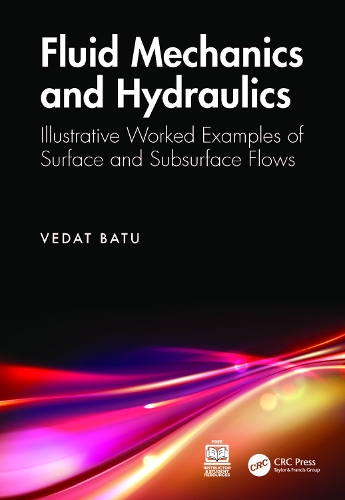
Fluid Mechanics and Hydraulics :Illustrative Worked Examples of Surface and Subsurface Flows
hardback
Published:
27 May, 2024

Popular Books by Vedat Batu
View All Books by Vedat Batu
Description
Fluid Mechanics and Hydraulics: Illustrative Worked Examples of Surface and Subsurface Flows presents the basic principles of fluid mechanics through the use of numerous worked examples. Some readers may have interest only in the application parts of various principles without paying too much attention to the derivation details of equations. Other readers may have interest both in derivation details and their applications. As a result, this book is designed to address both needs, and most derivation details are included as example problems. Therefore, those who are not interested in the details of derivations may skip them without interrupting the effective use of the book. It serves as an effective learning source for college students and as a teaching tool for instructors (with an included solutions manual), as well as for practicing professionals in the areas of fluid mechanics and hydraulics.
More Details
| Type | Book |
|---|---|
| ISBN13 | 9781032600789 |
| ISBN10 | 1032600780 |
| Number Of Pages | 1240 |
| Item Weight | 2173 g |
| Publisher / Reseller | Taylor & Francis Ltd |
| Format | hardback |
Media Reviews
Fluid Mechanics and Hydraulics
Illustrative Worked Examples of Surface and Subsurface Flows
Author: VEDAT BATU
This book presents valuable information to the readers in a user friendly and career-oriented manner in not only scientific terms, but also in comprehensible and meaningful forms. Theoretical and practical aspects of the relevant topics are systematically covered throughout the pages of the book.
The book is full of logical rational mathematical explanations of well-known methodologies, innovative techniques, and illustrative examples. Throughout the book, all relevant literature references are cited with their contributions, thus presenting the evolutionary development of fluid mechanics and hydraulics and its engineering aspects in a concise manner. In particular, the historical development stages of fluid mechanics deserve additional attention, followed by all current citations with clear and sustainable concepts.
The content of the book is divided into four sections, each covering the topics of fundamentals; vector analysis and integral theorems; ideal fluids and real fluids. The content is useful not only for theoretical scientific researchers, but more importantly, for those working on projects and applications in different companies related to the topics. Not only are the theoretical and practical aspects stated rationally, but they are also supported by original graphics, drawings and figures, improving visual examination and supporting the readers' rapid comprehension.
In the last part of the book, pipe hydraulics, fluid machinery and groundwater hydraulics bring together the theoretical mathematical equation derivations most needed in groundwater studies with reasonable explanations and field data. It is certain that groundwater hydraulics will become even more important due to climate change impacts.
I congratulate the author for providing deep learning opportunities in the field of fluid mechanics and hydraulics to the readers.
Zekâi Şen
Formerly with the Technical University of Istanbul
Currently with Istanbul Medipol University; Engineering and Natural Sciences Department
Fluid Mechanics and Hydraulics is an exceptional book in technical depth, writing style, and well-organized format. The book is especially suitable for mechanical, civil, and environmental engineers. The book focuses primarily on incompressible fluid with a modicum treatment of compressible fluid. The author is commended for covering a range of topics across twenty-nine chapters and over a thousand pages. Subjects include foundational and classical topics for ideal and real fluids, and applications of fluid flow to porous media, water hammer phenomenon, fluid machinery, open channels, water waves, pipe network, and flow around immersed objects, to name a few topics. The author also provides the reader with the necessary mathematical tools that render the book self-contained and holistic. The mathematical formulations include vector analysis, integral theorems, complex variables, conformal representation, Laplace, and Fourier transforms. The strength of the book lies in the detailed progression of theories, detailed explanation, and worked examples to reinforce concepts. The author’s attention to details renders this book invaluable for graduate students pursuing fluid mechanics research, and a practical reference and self-study guide for practicing engineers.
--R. N. Laoulache, independent scholar
Author's Bio
Vedat Batu graduated from the Civil Engineering Faculty of Istanbul Technical University (Istanbul, Tűrkiye) in 1969 with B.S and M.S degrees (combined) in the area of civil engineering. In the same year, he was appointed as an instructor in the Hydraulic Engineering Division of the Civil Engineering Department of Karadeniz Technical University (Trabzon, Tűrkiye). He received his Ph.D. in Hydraulic Engineering from Istanbul Technical University in 1974. He prepared his Associate Professorship thesis in Hydraulic Engineering in 1976-1977 at the University of Wisconsin, Madison. After the submittal of his thesis and passing all required examinations, he was appointed as an Associate Professor (Doçent) in the Department of Civil Engineering of Karadeniz Technical University in June 1979 and he worked as a faculty member until the end of 1982. Finally, he was the Chairman of the Civil Engineering Department. At the end of 1982, he voluntarily resigned from his position and went to the United States of America. He also served as a visiting professor in several universities in the United States and in the United Kingdom and then he joined the private sector in the US and worked on mostly environmental engineering-related projects. In Tűrkiye and the US, he taught many courses both at undergraduate and graduate levels, including hydraulic engineering, open channel hydraulics, hydrology, and ground water hydraulics for over 10 years. Since he received his PhD 1974, Dr. Batu has been involved in many scientific projects and published a number of authored and co-authored papers in some internationally-recognized journals including Ground Water, Journal of Hydrology, Journal of Hydraulic Engineering, Journal of Irrigation and Drainage Engineering, Soil Science Society of America Journal, and Water Resources Research. Dr. Batu has developed new concepts and approaches including many analytical and numerical models in the areas of aquifer hydraulics, vadose zone hydrology, and solute transport in aquifers. Besides this book, he is also the author of two others -- Aquifer Hydraulics and Applied Flow and Solute Transport Modeling. His original papers and books are cited and used as text books by many scientists and practitioners around the world, and these can be seen at http://scholar.google.com. Dr. Batu was appointed as a full professor in August 2008 in the Department of Civil Engineering of Yeditepe University (Istanbul, Tűrkiye). Currently, he is an employee of Argonne National Laboratory, Chicago, Illinois.