Hands-On Mathematical Optimization with Python
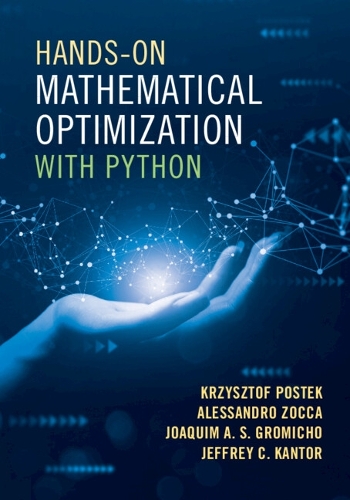
Hands-On Mathematical Optimization with Python
paperback
Published:
16 January, 2025

Description
More Details
| Type | Book |
|---|---|
| ISBN13 | 9781009493505 |
| ISBN10 | 1009493507 |
| Number Of Pages | 354 |
| Item Weight | 680 g |
| Product Dimensions | 178 x 254 x 20 mm |
| Publisher / Reseller | Cambridge University Press |
| Format | paperback |
Media Reviews
'This is a fantastic textbook on optimization! It contains the right mix of theoretical and more practical optimization aspects. Several chapters contain more recent important developments, e.g., conic and robust optimization. Moreover, the Python codes provided make this textbook really 'hands-on'. It is clear that the authors are not only experts in optimization theory, but also have applied optimization in practice themselves.' Dick den Hertog, University of Amsterdam
'This book delivers state-of-the-art models and their implementation. I highly recommend it to anyone interested in practical application of optimization.' David Woodruff, University of California, Davis
'This book is a great tool for instructors and students in Engineering, Business Analytics and many other areas for learning Mathematical Optimisation using Python code language. It is also good for senior researchers in Operations Research that are willing to adopt Python in their research and teaching.' Belen Martin-Barragan, University of Edinburgh
'Hands-On Mathematical Optimization with Python' fills a crucial gap in educational resources, providing both students and practitioners with an invaluable tool for mastering optimization models through practical Python programming. With clear guidance and hands-on exercises, this textbook empowers learners to not only understand but also implement optimization techniques effectively.' Bhupesh Shetty, Drexel University
'This book does an excellent job at teaching the reader how to set up and solve many types of optimization problems. It would be extremely useful to any practitioner of optimization theory across a multitude of applications. I believe that its readers will have gained very valuable expertise, since setting up an optimization formulation that reflects the problem at hand may often be the most challenging part. To maximize the book's utility, I would recommend its user to have a solid background on mathematical theory behind optimization techniques.' Slava Krigman, Boston University
'… I like it a lot. In particular, the Pyomo examples are excellent. The text is mainly aimed at a graduate student audience but there are portions that would be accessible to even a high school student and I may use some portions of the text to help craft my lectures to undergraduate students at my college.' Will Traves, United States Naval Academy
'This book fills a gap in the literature. It is a bridge between computer programming and mathematical optimization.' Joao Faria, Florida Atlantic University
Author's Bio
Krzysztof Postek is Senior Optimization Data Scientist with the Boston Consulting Group in Amsterdam. He received his Ph.D. in Operations Research in 2017 from Tilburg University. After his postdoc at the Technion – Israel Institute of Technology, he spent several years as a faculty member at Erasmus University Rotterdam and Delft University of Technology. His research interests revolve mostly around optimization under uncertainty. Alessandro Zocca is Assistant Professor in the Department of Mathematics at the Vrije Universiteit Amsterdam. He received his Ph.D. in Mathematics from the University of Eindhoven in 2015. He was a postdoctoral researcher first at CWI Amsterdam, and then at the California Institute of Technology, supported by a NWO Rubicon grant. His work lies in the area of applied probability, learning, and optimization, drawing motivation in particular from applications to power systems reliability. Joaquim A.S. Gromicho acts as Science and Education Officer for ORTEC and is full professor of Business Analytics at the University of Amsterdam. He received his Ph.D. in Optimization in 1995 from the Erasmus University Rotterdam, before spending two years as Assistant Professor at the University of Lisbon. He serves the Dutch Statistics and OR Society as editor in chief of STAtOR, a magazine on applications and impact, and the steering committee of the EURO Practitioner's Forum. Jeffrey C. Kantor earned his Ph.D. in Chemical Engineering from Princeton University in 1981. After a postdoc at the University of Tel Aviv, he joined the Chemical Engineering Department at the University of Notre Dame. His research interests focused on the theory and application of nonlinear control theory and techniques to chemical and biological processes. His awards have included an NSF Presidential Young Investigator Award, a Camille and Henry Dreyfus Research Scholar Award, and is a Fellow of the American Association for the Advancement of Science. He enjoyed modeling for optimization and contributed to the Pyomo community.