Hijacked :How Neoliberalism Turned the Work Ethic against Workers and How Workers Can Take It Back
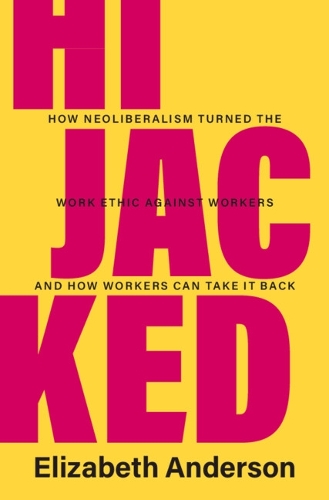
Hijacked :How Neoliberalism Turned the Work Ethic against Workers and How Workers Can Take It Back
hardback
Published:
21 September, 2023

Popular Books by Elizabeth Anderson
View All Books by Elizabeth Anderson



Description
More Details
| Type | Book |
|---|---|
| ISBN13 | 9781009275439 |
| ISBN10 | 1009275437 |
| Number Of Pages | 384 |
| Item Weight | 700 g |
| Product Dimensions | 160 x 235 x 26 mm |
| Publisher / Reseller | Cambridge University Press |
| Format | hardback |
Media Reviews
'Hijacked is an important and fascinating book that tells the spellbinding story of the struggle between conservatives and progressives over the Protestant work ethic. Nobody matches Anderson's distinctive combination of historical, political, and philosophical insight.' Stephen Darwall, author of Modern Moral Philosophy: From Grotius to Kant
'This critical examination of the Protestant work ethic and its evolution in social and economic theory outlines the challenges of preserving rewarding and purposeful work in liberal economies where free market capitalism has eroded both aspirations and capabilities, undermining the intrinsic dignity and meaning of work.' Richard Donkin, author of The History of Work
'Most of us will spend a significant part of our lives at work. But work conditions differ radically and the working poor often face brutal and dehumanizing workplaces. In this brilliant book, Anderson uncovers the role of a skewed version of the work ethic in shaping these harsh conditions. This skewed version turned the values of industry, prudence, and frugality against workers, while leaving the predatory and idle rich off the hook. Not only does Anderson offer a subtle diagnosis of the origins of today's stigmatization and deprivation of the poor, but she offers creative ideas for reclaiming the work ethic in the service of democracy. Her superb analysis, connecting political philosophy with both history and political economy, will stimulate wide debate.' Debra Satz, coauthor of Economic Analysis, Moral Philosophy, and Public Policy
'As rigorous as it is approachable, this poignant plea for worker dignity contextualizes one of today's most salient economic issues.' Publishers Weekly
'If we arm ourselves with Elizabeth Anderson's superb history of the work ethic, we obtain a powerful lens with which to explore at a perfect time - during party conference season - how different visions of work form the beating heart of ideological struggle.' Morning Star
'Hijacked is a substantial achievement - scholarly, rigorous, and rich in detail, with the author's learning evident on every page.' Helen Hester, Los Angeles Review of Books
'… compelling reading for everyone on the left and the right who needs employment in a paid job to survive, so today's neoliberal conservative work ethic no longer gaslights us to believe our dignity demands our exploitation.' Tim Gurner, LSE Review of Books
'Hijacked is compelling reading for everyone on the left and the right who needs employment in a paid job to survive, so today's neoliberal conservative work ethic no longer gaslights us to believe our dignity demands our exploitation.' Magdalene D'Silva, LSE Review of Books
'A lively, informative, clearly-written, and highly relevant history and examination of the work ethic … I highly recommend it, not merely to those with a special interest in the work ethic, but to researchers in many other fields along with as many members of the wider public as possible.' C. E. Emmer, Philosophy of Management
''Hijacked' is an entertaining and colourful (if also horrifying at times) reminder of how much contemporary social science and policy are path-dependent on history and ideological contestations.' Mark Fabian, The Economic Record
'All of Anderson's scholarly virtues are displayed in this book: rigor, subtlety, and commitments to both historicism and confronting present-day political dilemmas. She is careful to note how the work ethic emerged amid pivotal historical episodes of profound political and economic change, with dutiful references to historians as varied as Holly Brewer and Robert Allen. She has also mastered recent contemporary policy debates on issues ranging from private equity's impact on employment and welfare reform's effects on poverty. All of this is accomplished with her trademark clarity and moral urgency.' Joel Suarez, Journal of the History of Economic Thought
Author's Bio
Elizabeth Anderson is the Max Mendel Shaye Professor of Public Philosophy, Politics, and Economics at University of Michigan. She is the author of Value in Ethics and Economics (1995), The Imperative of Integration (2010), and Private Government: How Employers Rule Our Lives (and Why We Don't Talk about It) (2017). She is a MacArthur Fellow and Fellow of the American Academy of Arts and Sciences. In 2019, The New Yorker described her as 'a champion of the view that equality and freedom are mutually dependent […] Anderson may be the philosopher best suited to this awkward moment in American life.'