Demystifying the Chinese Economy
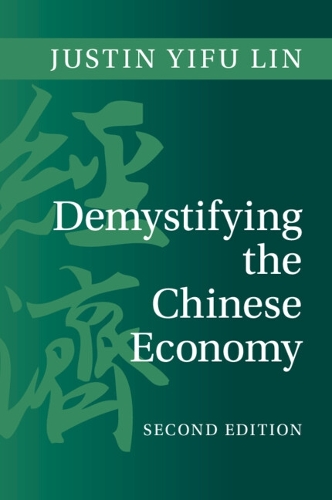
Demystifying the Chinese Economy
paperback
Published:
8 January, 2026

Popular Books by Justin Yifu Lin
View All Books by Justin Yifu Lin


Description
More Details
| Type | Book |
|---|---|
| ISBN13 | 9781009209298 |
| ISBN10 | 1009209299 |
| Number Of Pages | 432 |
| Item Weight | 621 g |
| Product Dimensions | 152 x 229 x 22 mm |
| Publisher / Reseller | Cambridge University Press |
| Format | paperback |
| Edition | 2nd Revised edition |
Media Reviews
'No one knows the Chinese economy better than Justin Lin, and there's no one better placed to describe its essential workings. A unique perspective on the Chinese miracle from a unique perch.' Barry Eichengreen, George C. Pardee and Helen N. Pardee Professor of Economics and Political Science, University of California, Berkeley
'Justin Lin's Demystifying the Chinese Economy is a tour de force. The book succeeds at many levels. It presents a broad historical perspective over two millennia of the rise, fall, and dramatic resurgence of Chinese economic power. It presents an analytically informative study of the sources of Chinese economic growth and the prospects of growth for the future. Lin formalizes the successful pragmatic Chinese approach to economic development using his insightful notion of comparative advantage-following (CAF) strategies. The book challenges many tenets of conventional neoclassical theory and shows how naive application of many of its principles had catastrophic consequences for many transition economies.' James J. Heckman, Henry Schultz Distinguished Service Professor of Economics, 2000 Nobel Prize in Economics, University of Chicago
'This book considers fundamental questions about the great transformation of China from a poor underdeveloped country to a global leader in modern economic growth. These are among the most important questions of our time, and Justin Lin has the best credentials to help us understand them. In this book, he offers a new and important perspective on the conditions for modern economic development in China and the world.' Roger Myerson, Glen A. Lloyd Distinguished Service Professor of Economics, 2007 Nobel Prize in Economics, University of Chicago
'This clear and insightful study of the origins of China's failures and, finally, its extraordinary success will be must-reading for anyone who wants to understand Chinese development. An important book and much overdue.' Edmund S. Phelps, McVickar Professor of Political Economy, 2006 Nobel Prize in Economics, Columbia University
Author's Bio
Justin Yifu Lin is the Dean of Institute of New Structural Economics and Institute of South-South Cooperation and Development and Honorary Dean, School of National Development at Peking University. He was formerly the Senior Vice President and Chief Economist of the World Bank in 2008–2012. Prior to joining the Bank, he served for 15 years as Founding Director and Professor of the China Centre for Economic Research (CCER) at Peking University. He is a Corresponding Fellow of the British Academy and a Fellow of the Academy of Sciences for Developing World. He was awarded the 1993 and 2001 Sun Yefang Prize (the highest honour for economists in China).