Mortuary Feasting on New Ireland :The Activation of Matriliny Among the Sursurunga
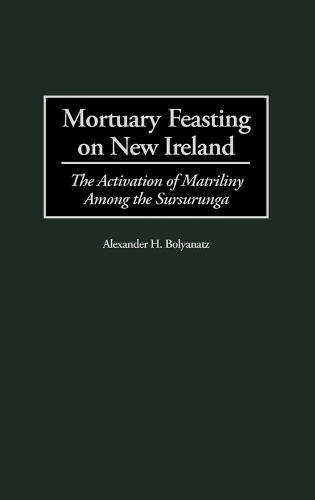
Mortuary Feasting on New Ireland :The Activation of Matriliny Among the Sursurunga
hardback
Published:
30 July, 2000

Popular Books by Alexander H. Bolyanatz
View All Books by Alexander H. Bolyanatz
Description
Contrary to conventional anthropological understanding, descent groups need not always be wealth- or office-transmitting groups, but can be principally feast-sponsoring groups. Sursurunga matrilineages are activated by individual's combined participation in feasting events, but individual's reasons for participating in feasts vary and often have little to do with matrilineal group membership.
This study of Sursurunga mortuary feasting shows that the analysis of groups-in this case, matrilineal descent groups-is best conducted by attention to the reasons that the individuals who comprise those groups act as they do. The salience of group membership cannot be seen as simply the blueprint for social life, but also as the outcome of social life.
More Details
| Type | Book |
|---|---|
| ISBN13 | 9780897897211 |
| ISBN10 | 0897897218 |
| Number Of Pages | 208 |
| Item Weight | 1000 g |
| Publisher / Reseller | Bloomsbury Publishing Plc |
| Format | hardback |
Media Reviews
"From the perspective of Susurunga language, cognition, and mortuary practice, Bolyanatz provides vital new insights into how matriliny is constituted and experienced. Through his analysis, kinship ceases to consist of systems of abstract principles, but instead becomes embedded in key moments in people's lives that are laden with meaning and emotion. This approach breathes new life into the study of one anthropology's great debates, the persistence of matrilineal descent, and it raises crucial issues for the study of kinship, in general." Kevin Birth, Queens, CUNY; "Bolyanatz's finely researched and winsomely written account of Sursurunga kinship offers great insights not only into the local phenomena that constitute kinship, but more generally into the dialectic between social structure and activity, especially mortuary feasting. His orientation to action, history, and persons leads him to explore the power of linguistic categories in actual discourse to make salient or perhaps even constitute the lived meanings of relatedness for Sursurunga people. His book thus makes rewarding reading for students of society, language, and structuration." Jim Wilce, Assistant Professor, Anthropology Department, Northern Arizona University
Author's Bio
ALEXANDER H. BOLYANATZ is Assistant Professor of Anthropology, Benedictine University.