Change and Continuity in Minangkabau :Local, Regional, and Historical Perspectives on West Sumatra - Research in International Studies, Southeast Asia Series
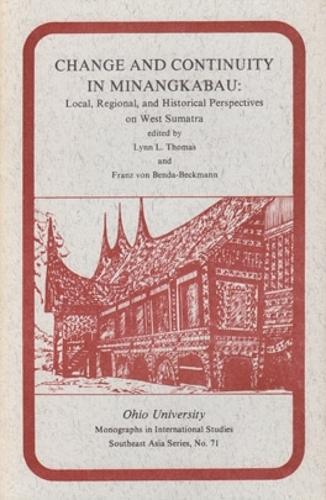
Change and Continuity in Minangkabau :Local, Regional, and Historical Perspectives on West Sumatra - Research in International Studies, Southeast Asia Series
paperback
Published:
1 March, 1986

Popular Books by Franz Von Benda-Beckmann
View All Books by Franz Von Benda-Beckmann
Description
Social scientists have long recognized many apparent contradictions in the Minangkabau. The world's largest matrilineal people, they are also strongly Islamic and, as a society, remarkably modern and outward looking.
Focusing on Minangkabau proper, and treating several adjacent areas as well, this collection examines the resilience and adaptability of the Minangkabau in the face of outside political and economic pressures and of distortions in social science and legal theory. Individual studies address issues of kinship and other forms of social organization, ideology, and political and economic life. Together, they emphasize the integrity of Minangkabau social forms while revealing fascinating patterns of continuity and change in Minangkabau culture.
This collection will be of particular interest to anthropologists specializing in Southeast Asia, but it will also be important reading for those concerned with the issue of change and continuity in the third world generally.
More Details
| Type | Book |
|---|---|
| ISBN13 | 9780896801271 |
| Number Of Pages | 360 |
| Item Weight | 1000 g |
| Publisher / Reseller | Ohio University Press |
| Format | paperback |
Media Reviews
"…some of the finest essays ever written on the matrilineal system of Minangkabau and their cultural areas are found in this volume. … Plainly put, this is an important book indeed which will be referred to for a long time by anthropologists and Southeast Asianists." (Journal of Southeast Asia Studies) "…The variety of topics and the quality of scholarship reflected in this book make it essential reading for students of Minangkabau as well as an extremely useful introduction for new readers to the diversity and richness of Minangkabau studies." (Amercian Anthropologist)