The Passivhaus Handbook :A practical guide to constructing and retrofitting buildings for ultra-low energy performance - Sustainable Building
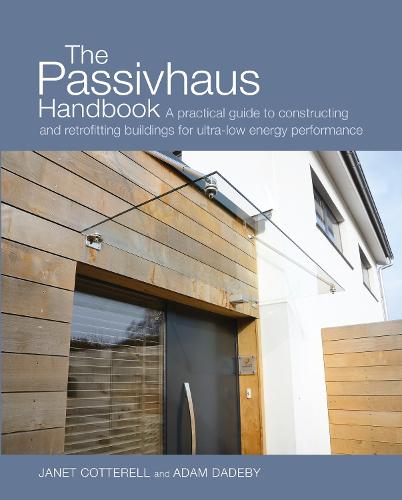
The Passivhaus Handbook :A practical guide to constructing and retrofitting buildings for ultra-low energy performance - Sustainable Building
paperback
Published:
25 October, 2012

Description
'As we move towards the 2016 zero carbon target in house building, Passivhaus construction looks like becoming not just popular in the UK, but commonplace. This is a no-nonsense and engaging introduction on how to do it.' KEVIN MCCLOUD
-
The Passivhaus Handbook is an essential guide for anyone wanting to realise a supremely comfortable, healthy and durable home with exceptionally low energy costs.
Passivhaus design focuses on getting the building fabric right, to achieve ultra-low energy consumption cost-effectively. The approach is relevant to a wide range of building types and climates. Its methodology can be combined with elements of other building standards, such as the UK’s Code for Sustainable Homes (CSH), or with other sustainable building goals, such as a commitment to using low-impact or natural building materials.
Whether you are building an extension, retrofitting your house or starting from scratch, and whether you are new to low-energy design or already have some experience, this book will help you navigate around the potential pitfalls and misconceptions. It brings together current thinking and best practice.
The book includes a clear explanation of the underlying building physics and terminology, as well as detailed information on key elements of Passivhaus: avoiding air leakage, designing thermal (cold) bridges, moisture management and ventilation strategy. There is also lots of practical advice on setting up a project, including developing a motivated project team, and a discussion of economic considerations and the policy context in the UK.
As pressure on global resources increases and energy prices continue to rise, the Passivhaus approach, proven over 20 years, meets the challenge of ultra-low-energy building for the future.
More Details
| Type | Book |
|---|---|
| ISBN13 | 9780857840196 |
| ISBN10 | 0857840193 |
| Number Of Pages | 256 |
| Item Weight | 890 g |
| Product Dimensions | 200 x 254 x 16 mm |
| Publisher / Reseller | Bloomsbury Publishing PLC |
| Format | paperback |
Media Reviews
As we move towards the 2016 zero carbon target in house building, Passivhaus construction looks like becoming not just popular in the UK, but commonplace. This is a no-nonsense and engaging introduction on how to do it. * Kevin McCloud *
This excellent book acts both as an introduction to the details of the Passivhaus methodology and how it works in practice. Anyone who has clients who have expressed interest in a Passivhaus project would be well advised to suggest they get a copy of the book, as it is extremely well written and accessible. * Dave Palmer FBEng RIBA *
This book gives a wonderful overview of Passivhaus in the UK today, not only enabling interested parties to understand the principles and pitfalls for their own projects, but also for policy makers and planning officers to understand how to avoid some of their ‘own goals’ in attempting to encourage conservation. * Peter Warm, Passivhaus Consultant, Trainer and Certifier *
The Passivhaus Handbook really is the ‘bible’ for developing passivhaus housing, particularly if you are thinking of a self-build passivhaus. * Elrond Burrell, Passivhaus in Plain English *
I‘m delighted to see everything about Passivhaus and its application in the UK collated for the first tiime, in The Passivhaus Handbook. The first-hand experience of the authors provides an excellent grounding for the book. * Jon Bootland, Chief Executive, Passivhaus Trust *
GoodReads Reviews
Author's Bio
Janet Cotterell has wide experience of working in sensitive settings (conservation areas, listed buildings, historic parks), so is familiar with the use of traditional and natural materials. Her focus is on the importance of sustainable building practice and low-energy design principles. She is a chartered architect and a Certified Passivhaus Designer and holds an MSc in Architecture: Advanced Environmental & Energy Studies.
Adam Dadeby is interested in different approaches to ‘sustainability’ and ‘resilience’ as they affect building practice. He is a Certified Passivhaus Consultant and member of the AECB (the Sustainable Building Association) and holds a postgraduate diploma in Architecture: Advanced Environmental & Energy Studies from the Centre for Alternative Technology (CAT).