The Palm Springs School
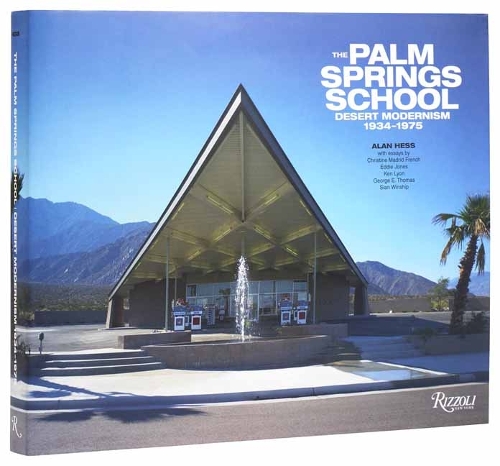
The Palm Springs School
hardback
Published:
11 February, 2025

Popular Books by Alan Hess
View All Books by Alan Hess



Description
More Details
| Type | Book |
|---|---|
| ISBN13 | 9780847842551 |
| ISBN10 | 084784255X |
| Number Of Pages | 256 |
| Item Weight | 1000 g |
| Publisher / Reseller | Rizzoli International Publications |
| Format | hardback |
Media Reviews
Publishers Weekly Holiday Gift Guide 2025 (Illustrated & Art Books): "Examining the various forces that nurtured desert modernism, Hess highlights dozens of key players and standout buildings. Richard Neutra’s work includes the Kaufmann house (1946), commissioned by the couple who’d hired Frank Lloyd Wright to build Fallingwater in Mill Run, Penn. John Lautner, known for pioneering the atomic age Googie style, also designed, among other Palm Springs projects, the Hope house (1979), whose curving tortoise-shell roof typifies organic modernism. The collection of commercial buildings, private homes, and public spaces on display are a feast for midcentury mod fans."
"Few locations are as synonymous with architecture as Palm Springs, California: Almost 100 years on, its modernist marvels remain in deep conversation with the remote, beguiling desert landscape. Alan Hess, an architect and historian, sheds light on the evolving vernacular first introduced by Frank Lloyd Wright in 1924 with the Oasis Hotel, and later popularized by the likes of Richard Neutra’s daring glass boxes, John Lautner’s futuristic forms, and Albert Frey’s industrial creations. Stunning archival photographs add vibrancy to this canonical coffee table book." — ARCHITECTURAL DIGEST
"Palm Springs is often seen as a picturesque California resort town, but it also played a significant yet unsung role in the modernist movement. Architects from various backgrounds have come together in this new book to examine how Palm Springs influenced desert modernism style and how those traditions continue to impact contemporary architecture." — VERANDA
"Palm Springs is at the center of a unique tradition in architecture marked by invention and a sensitivity to local conditions that has resulted in design that exerts an influence far greater than the town's small size. "The Palm Springs School: Desert Modernism 1934-1975" is a seminal and groundbreaking study that fully explores the wide ranging forms this architecture has taken, from houses to gas stations, hotels to airports, banks to restaurants and spas." — MIDWEST BOOK REVIEW
"Across the book, you sense a localized “space race” of ideas—architects using the desert’s remoteness to experiment with new materials, new technologies, and new ways of living in a rapidly developing environment. What was once a patchwork of date farms, health retreats, and modest tourist cabins became, almost improbably, a full-fledged laboratory of the Modern." — ARTNET.COM
Author's Bio
Architect and historian Alan Hess is author of twenty-one books on Modern architecture and urbanism; his subjects include John Lautner, Oscar Niemeyer, the Ranch House, Las Vegas, and Palm Springs. Eddie Jones, a practicing Arizona architect, discusses the unique environment of the American Southwest and regional challenges shared with the Palm Springs School. Ken Lyon traces the evolution and national impact of the historic preservation of Modern Palm Springs from his perspective as a city planner in the desert city. Christine Madrid French, historian and Florida preservationist, compares the architecture of the famous Sarasota School with the newly identified Palm Springs School. George E. Thomas, Ph.D., writes on the role of American resort communities as a social and economic phenomenon crossing class lines and producing influential architectural innovations. Historian Sian Winship's original research uncovers the crucial role of the Agua Caliente Band of Cahuilla Indians in the development of Palm Springs in the mid-twentieth century.