"We, the Barbarians" :Three Mexican Writers in the Twenty-First Century - Critical Mexican Studies
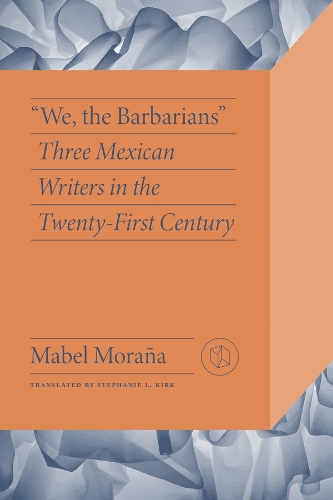
"We, the Barbarians" :Three Mexican Writers in the Twenty-First Century - Critical Mexican Studies
paperback
Published:
31 May, 2024
paperback
Published:
31 May, 2024

Standard worldwide delivery by
Fri, June 19 - Wed, June 24
Order within
0
Popular Books by Mabel Moraña
View All Books by Mabel Moraña
Description
We the Barbarians embarks on a careful and exhaustive reading of three of the most prominent authors in the latest wave of Mexican fiction: Yuri Herrera, Fernanda Melchor, and Valeria Luiselli. Originally published in Mexico in December of 2021, the work is divided into three parts that correspond to the analysis of each author’s narrative production. The book analyzes all the literary works published by Herrera, Melchor, and Luiselli from the beginning of their writing careers until 2021, allowing for a diachronic interpretation of their respective narrative projects as well as for comparative approaches to their aesthetic and ideological contours.
Characterized by the fragmentation of civil society and the decomposition of the myths that accompanied the consolidation of the modern nation, Mexican visual and literary arts have been exploring a myriad of representational avenues to approach the phenomena of violence, institutional decay, and political instability. We the Barbarians analyzes the ways in which the transformations of national culture intersect with global developments, discussing the insertion of literary works at transnational levels. In the works of the authors studied here, the uses of language reveal the experimental integration of regional idiolects, colloquialisms, slang, and neologisms derived from multiple and diverse cultural registers, including the terminologies of social media. Urban and rural subcultures interplay with traditional currents and with the languages of film, performance, and popular music. Thematically, innovations introduced through the genre of chronicles, science fiction, journalism, and autobiographical writing produce powerful combinations in which "canonical" authors are re-interpreted and re-vitalized for a changing and diversified cultural market.
The critical and theoretical approaches used here explore a variety of alternative symbolic representations of topics such as nationalism, community, and affect in times impacted by systemic violence, precariousness, and radical inequality. Moraña's goal is to perceive the negotiations between regional/local imaginaries and global scenarios characterized by the devaluation and re-signification of life, both at individual and at collective levels. Though it uses three authors as its focus, the book seeks to more broadly theorize the question of the relationship between literature and the social in the twenty-first century.
Characterized by the fragmentation of civil society and the decomposition of the myths that accompanied the consolidation of the modern nation, Mexican visual and literary arts have been exploring a myriad of representational avenues to approach the phenomena of violence, institutional decay, and political instability. We the Barbarians analyzes the ways in which the transformations of national culture intersect with global developments, discussing the insertion of literary works at transnational levels. In the works of the authors studied here, the uses of language reveal the experimental integration of regional idiolects, colloquialisms, slang, and neologisms derived from multiple and diverse cultural registers, including the terminologies of social media. Urban and rural subcultures interplay with traditional currents and with the languages of film, performance, and popular music. Thematically, innovations introduced through the genre of chronicles, science fiction, journalism, and autobiographical writing produce powerful combinations in which "canonical" authors are re-interpreted and re-vitalized for a changing and diversified cultural market.
The critical and theoretical approaches used here explore a variety of alternative symbolic representations of topics such as nationalism, community, and affect in times impacted by systemic violence, precariousness, and radical inequality. Moraña's goal is to perceive the negotiations between regional/local imaginaries and global scenarios characterized by the devaluation and re-signification of life, both at individual and at collective levels. Though it uses three authors as its focus, the book seeks to more broadly theorize the question of the relationship between literature and the social in the twenty-first century.
More Details
| Type | Book |
|---|---|
| ISBN13 | 9780826506696 |
| ISBN10 | 0826506690 |
| Number Of Pages | 408 |
| Item Weight | 1000 g |
| Publisher / Reseller | Vanderbilt University Press |
| Format | paperback |
See More +
Media Reviews
“What is most interesting here is MoraÑa’s cross-reading of her writers, the originality of the approach, and the great lengths she goes to interpret the linguistic, political, and cultural importance of Herrera, Melchor, and Luiselli, three young writers that are in the center of the revival of Mexican literature translated into English.” —Pedro Ángel Palou, author of Mestizo Failure(s): Race, Film, and Literature in Twentieth-Century Mexico
Author's Bio
Mabel Moraña is a professor of Spanish at Washington University in St. Louis.
Stephanie Kirk is a translator and professor of Hispanic studies at Washington University in St. Louis, working on Latin American literature and translation studies.