The New Atheist Novel :Philosophy, Fiction and Polemic after 9/11 - New Directions in Religion and Literature
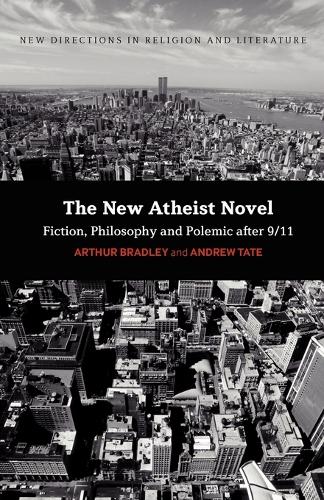
The New Atheist Novel :Philosophy, Fiction and Polemic after 9/11 - New Directions in Religion and Literature
paperback | English
Published:
11 February, 2010

Popular Books by Arthur Bradley
View All Books by Arthur Bradley

Description
More Details
| Type | Book |
|---|---|
| ISBN13 | 9780826446299 |
| ISBN10 | 0826446299 |
| Number Of Pages | 160 |
| Item Weight | 190 g |
| Publisher / Reseller | Bloomsbury Publishing PLC |
| Format | paperback |
Media Reviews
A contentious and well-informed appraisal of four major novelists, whose work deals with the central problems of our times, this clearly-written and clear-headed book is an excellent and timely analysis of the fraught intersections between contemporary fiction, religion, politics and thought. It should be read by all those with an interest in contemporary fiction. -- Robert Eaglestone, Professor of Contemporary Literature and Thought, Department of English, Royal Holloway, University of London, UK
In comparison to the endless paeans of praise figures such as McEwan, Rushdie and Amis regularly receive, what we have here is an intelligent, critical and highly original re-reading of their work. Probably the most unsettling aspect of this startling book is the suggestion that some of the most central figures in contemporary British literature embody a profound Neo-Conservatism, one which - through its admiration of a rabid 'New Atheism' and a rage against all things Islamic - finds itself in wholesale agreement with the main tenets of the 'War on Terror' . . . I don't think I'll ever read McEwan or Amis quite as innocently again. -- Ian Almond, Professor of Transnational Literatures, Georgia State University, USA
A timely and important work examining four of the most lionised novelists with an appropriately aporetic eye. -- Times Higher Education
"This reviewer...was not disappointed in the subject, the writing, the research or the outcome of this study." -David Rosman, New York Journal of Books
‘Arthur Bradley and Andrew Tate's excellent new book The New Atheist Novel is an important contribution to this counter-movement: counter-new-atheist that is, but without being ‘religious' itself.' -- The Glass
I congratulate Arthur Bradley and Andrew Tate on this interesting and... beautifully written book. It is a real pleasure when one has so often read books that show so clearly the bias of the author(s) to read a book of such balance and erudition. -- Journal of Contemporary Religion, Vol. 27, No. 1
Author's Bio
Arthur Bradley is Senior Lecturer in Literary and Cultural Studies at Lancaster University, UK. Andrew Tate is Senior Lecturer in the Department of English and Creative Writing at Lancaster University, UK.