Death Now :Chronicles of Intellectual Life, 1944
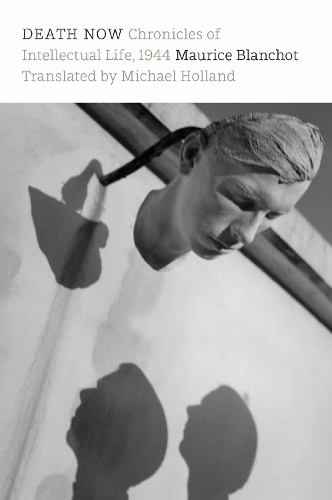
Death Now :Chronicles of Intellectual Life, 1944
paperback
Published:
2 October, 2018

Popular Books by Maurice Blanchot
View All Books by Maurice Blanchot

Description
The book offers both literary journalism from one of the twentieth century's major writers, as well as a snapshot of the complex, conflicting currents of literary and intellectual activity during the last months of German occupation and Vichy government in France.
By 1944, the days of Germany's domination of Europe are numbered, and defeat seems no more than a matter of time. In occupied France, there is renewed activity on the political and the cultural fronts, in anticipation of the liberation that now appears inevitable. Already the author of two novels and a volume of criticism, Maurice Blanchot is henceforth fully established as a major figure in what will soon be post-war France.
Blanchot's position in this new order is problematical, however. Despite having discreetly supported the Resistance, he makes clear that his only true allegiance is to literature. Against the tide of his own emerging reputation, he is increasingly drawn to silence as the only valid response to what the world has become. For him, ruin cannot be reconstructed with the aid of literature, because ruin is the mode in which literature most authentically exists. Disaster has long been the writer's lot, with which the world has only now caught up. Politics and literature coexist in what he will call the "abyss of the present," and neither offers any prospect for the future.
This grim and potentially nihilistic message seems to make Blanchot into little more than an anachronism in the emerging post-war world. Yet his attitude is the very opposite of aloofness. Silence becomes for him an intense search for a language commensurate with "circumstances that literature can still neither express directly nor distort". Beyond this volume, which completes the English publication of his wartime literary journalism, his writing over the next fifty years will patiently establish a margin in which new forms thought will offer themselves to a new age.
More Details
| Type | Book |
|---|---|
| ISBN13 | 9780823281794 |
| ISBN10 | 0823281795 |
| Number Of Pages | 176 |
| Item Weight | 1000 g |
| Publisher / Reseller | Fordham University Press |
| Format | paperback |
| Edition | New edition |
Media Reviews
"The time has come to pay attention to Blanchot's early literary and political journalism (his missteps included) which, surprisingly, the first generation of his postwar admirers barely noted. It reminds us, among other things, that this major theoretician of literary modernity has never been associated with academia. The discipline of the newspaper was his first critical exercise. This volume collects, in chronological order, the articles Blanchot published weekly for the literary page of Le Journal des de bats during the year 1944 and, in doing so, provides a remarkably rich overview of the French literary atmosphere during these fateful days. It is also unmistakably haunted by the ghost of a Blanchot to come." -- Denis Hollier, New York University
Author's Bio
Maurice Blanchot (Author)
Maurice Blanchot (1907–2003)—writer, critic, and journalist—was one of the most important voices in twentieth-century literature and thought. His books include Thomas the Obscure, The Instant of my Death, The Writing of the Disaster, and The Unavowable Community.
Michael Holland (Translator)
Michael Holland is a Fellow of St Hugh's College, Oxford.