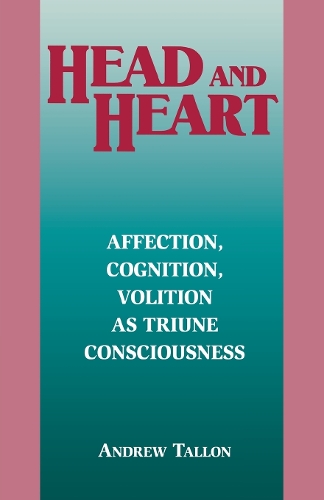
Head and Heart :Affection, Cognition, Volition, As Truine Consciousness
Head and Heart :Affection, Cognition, Volition, As Truine Consciousness
paperback
Published:
1 January, 1997

Popular Books by Andrew Tallon
View All Books by Andrew Tallon



Description
More Details
| Type | Book |
|---|---|
| ISBN13 | 9780823217724 |
| ISBN10 | 0823217728 |
| Number Of Pages | 334 |
| Item Weight | 1000 g |
| Publisher / Reseller | Fordham University Press |
| Format | paperback |
Media Reviews
"This book joins a growing number that argue that emotions have been incorrectly accorded second-class status. These include Robert C. Solomon's The Passions (CH, Jan'77), Ronald DeSousa's The Rationality of Emotion (CH, Jun'88), Damasio's Descartes' Error (1994), W. George Turski's Toward a Rationality of Emotions (CH, Dec'94), and the popular Emotional Intelligence (1995), by Daniel Goleman. Yet Tallon's book differs in both its method and content, moving to integrate consciousness under a single principle. In the first, and phenomenological, half of the book, Tallon (Marquette Univ.) argues that intentionality provides the single principle with which to integrate head and heart. Feeling is best understood as "affective intentionality." In the second, the hermeneutical half, Tallon interprets the phenomenon and proposes a theory to account for it. The principle of affective intentionality makes possible his thesis that cognition (the head), affectivity (the heart), and volition (the will) together form a "triune consciousness." Not only does affectivity cooperate with cognition, together they offer optimal human performance. He uses for support a variety of sources, mostly from the Continental tradition of phenomenology and existentialism, such as Sartre, Ricoeur, Heidegger, and Merleau-Ponty. Upper-division undergraduate; graduate; faculty." -Choice
Author's Bio
Andrew Tallon is Professor of Philosophy at Marquette University and director of Marquette University Press.