Concrete and Countryside :The Urban and the Rural in 1950s Puerto Rican Culture - Illuminations
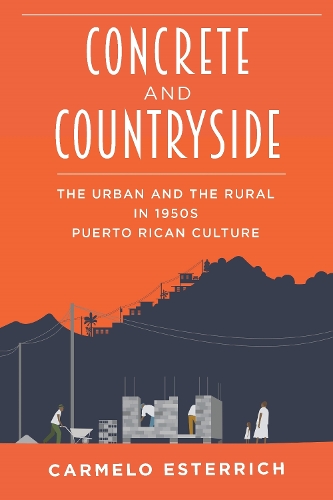
Concrete and Countryside :The Urban and the Rural in 1950s Puerto Rican Culture - Illuminations
paperback
Published:
7 May, 2018

Popular Books by Carmelo Esterrich
View All Books by Carmelo Esterrich
Description
From the late 1940s to the early 1960s, Puerto Rico was swept by a wave of modernization, transforming the island from a predominantly rural society to an unquestionably urban one. A curious paradox ensued, however. While the island underwent rapid urbanization, and the rhetoric of economic development reigned over official discourses, the newly installed insular government, along with some academic circles and radio and television media, constructed, promoted, and sponsored a narrative of Puerto Rican culture based on rural subjects, practices, and spaces.
By examining a wide range of cultural texts, but focusing on the film production of the Division of Community Education, the popular dance music of Cortijo y su combo, and the literary texts of Jose Luis Gonzalez and Rene Marques, Concrete and Countryside offers an in-depth analysis of how Puerto Ricans responded to this transformative period. It also shows how the arts used a battery of images of the urban and the rural to understand, negotiate, and critique the innumerable changes taking place on the island.
More Details
| Type | Book |
|---|---|
| ISBN13 | 9780822965398 |
| ISBN10 | 0822965399 |
| Number Of Pages | 184 |
| Item Weight | 1000 g |
| Publisher / Reseller | University of Pittsburgh Press |
| Format | paperback |
Media Reviews
Concrete and Countryside represents a valuable, much-welcomed intervention and contribution to cultural studies, Latin American and Caribbean studies, Puerto Rican studies, and literary studies in general. Esterrich's work is theoretically and methodologically sound.
* Agustin Lao-Montes, University of Massachusetts-Amherst *A timely project, well-conceived and executed. General readers as well as specialists will be able to navigate this text.
* Jason Cortes, Rutgers University-Newark *"Skillfully applying the conceptual framework of Raymond Williams and the Birmingham School to key instances of Puerto Rico's mid-century cultural production, Esterrich has given us a fresh look at an otherwise much-studied moment of its modern history. The book's most important contribution is its examination of the deployment of urban and rural themes in the songs of Rafael Cortijo y su combo, Puetro Rico's most influential and culturally relevant popular/commercial music ensemble of the twentieth century, alongside other 1950s cultural texts, including the films of the Division of Community Education (DIVEDCO), as well as key works of fiction and the visual arts. . . . Esterrich's book is a welcome contribution to the cultural studies and social history of modern Puerto Rico that suggests fertile avenues for the analysis of contemporary discourses and processes.
* Journal of Social History *A fantastic snapshot of midcentury Puerto Rican culture. It will be of interest to those who want to learn more about Puerto Rico in Latin American context of twentieth-century modernization, and anyone more broadly interested in cultural responses to global trends of migration and urbanization.
* H-Net Reviews *[T]his book will be of interest to those who enjoy reading about modernism, post-modernism, capitalism, industrialization, urbanization, migration, and cultural production as well as how it manifested itself in midcentury modern Puerto Rico.
* Ivis García, Centro Journal *The book should be widely read by students and scholars of twentieth-century Puerto Rico and will provide fertile grounds for comparison with similar cultural products and modernization programs in Latin America.
* Hispanic American Historical Review *Author's Bio
Carmelo Esterrich is associate professor of Spanish, humanities, and cultural studies at Columbia College Chicago. He has published widely on cultural and artistic production in Latin America.