Desert Cities :The Environmental History of Phoenix and Tucson - History of the Urban Environment
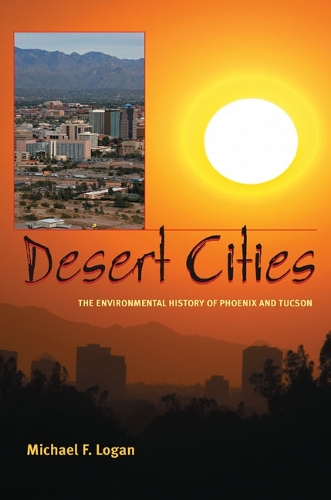
Desert Cities :The Environmental History of Phoenix and Tucson - History of the Urban Environment
paperback
Published:
15 November, 2006

Popular Books by Michael Logan
View All Books by Michael Logan



Description
Phoenix is known as the "Valley of the Sun," while Tucson is referred to as "The Old Pueblo." These nicknames epitomize the difference in the public's perception of each city. Phoenix continues to sprawl as one of America's largest and fastest-growing cities. Tucson has witnessed a slower rate of growth, and has only one quarter of Phoenix's population. This was not always the case. Prior to 1920, Tucson had a larger population. How did two cities, with such close physical proximity and similar natural environments develop so differently?Desert Cities examines the environmental circumstances that led to the starkly divergent growth of these two cities. Michael Logan traces this significant imbalance to two main factors: water resources and cultural differences. Both cities began as agricultural communities. Phoenix had the advantage of a larger water supply, the Salt River, which has four and one half times the volume of Tucson's Santa Cruz River. Because Phoenix had a larger river, it received federal assistance in the early twentieth century for the Salt River project, which provided water storage facilities. Tucson received no federal aid. Moreover, a significant cultural difference existed. Tucson, though it became a U.S. possession in 1853, always had a sizable Hispanic population. Phoenix was settled in the 1870s by Anglo pioneers who brought their visions of landscape development and commerce with them.By examining the factors of watershed, culture, ethnicity, terrain, political favoritism, economic development, and history, Desert Cities offers a comprehensive evaluation that illuminates the causes of growth disparity in two major southwestern cities and provides a model for the study of bi-city resource competition.
More Details
| Type | Book |
|---|---|
| ISBN13 | 9780822961314 |
| ISBN10 | 0822961318 |
| Number Of Pages | 240 |
| Item Weight | 1000 g |
| Publisher / Reseller | University of Pittsburgh Press |
| Format | paperback |
Media Reviews
Desert Cities offers a valuable new approach to the well-studied topic of urban competition. By factoring in the key roles of both ethnicity and the natural environment in shaping the divergent development of Phoenix and Tucson, Michael Logan successfully blends the interests of urban history, environmental history, and borderlands history.
* Carl Abbott, Portland State University *A broad and important study that adds to a growing literature that stresses the need to continue to think and write about the environmental histories of cities.
* Western Historical Quarterly *Meticulously documents the causes of the growth disparity between Tucson and Phoenix. More than a scholarly text, 'Desert Cities' is relevant, provocative and highly recommended.
* Tucson Citizen *Those interested in a succinct history of Arizona's chief metropolitans, emphasizing the influence of the environment should enjoy this work.
* Journal of the West *"Desert Cities takes an interesting approach to understanding the confluence of urbanization and environment in two of the fastest growing cities in the United States today. And because of its clear and engaging writing style, it's the kind of scholarly text that can easily cross over to a more popular audience."
* Sallie A. Marston, University of Arizona *Author's Bio
Michael F. Logan is professor of history at Oklahoma State University.