Africa in the Indian Imagination :Race and the Politics of Postcolonial Citation
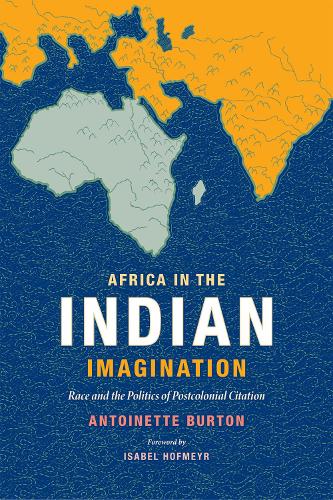
Africa in the Indian Imagination :Race and the Politics of Postcolonial Citation
paperback
Published:
1 April, 2016

Popular Books by Antoinette Burton
View All Books by Antoinette Burton


Description
More Details
| Type | Book |
|---|---|
| ISBN13 | 9780822361671 |
| ISBN10 | 0822361671 |
| Number Of Pages | 200 |
| Item Weight | 249 g |
| Publisher / Reseller | Duke University Press |
| Format | paperback |
Media Reviews
"A highly stimulating study of the (dis)continuities of colonial discourses of race and gender into the framework of transnational solidarity inspired by the Bandung spirit. . . . Burton’s book offers a major contribution to our understanding of how India imagined Africa (and, consequently, itself as an independent nation state) and raises the important challenge of re-thinking and complicating the postcolonial histories of Afro-Asian connections." - Luca Raimondi (African Studies Quarterly) "[Burton's] work implores scholars to locate new archives and tell more nuanced interpretations of the global south. She also encourages readers to reconsider the significance of race and gender in challenging and at times undermining the rhetorical and material projects developed under the banner of Afro-Asianism. Burton’s work will certainly stimulate a robust and welcome debate." - Michele Louro (Canadian Journal of History) "The book makes powerful theoretical contributions by desegregating Indian and African histories across the postcolonial Indian Ocean region, infusing their study with feminist historical methods, and writing race into geopolitics." - Ned Bertz (Journal of African History) "Ambitious and theoretically rigorous. . . . Burton engages with an impressive range of scholarship as she complicates our understanding of Indian-African interactions and raises larger issues dealing with the legacy of imperialism and the development of the postcolonial state." - Timothy Nicholson (Ufahamu) “Antoinette Burton is a master historian, who has proven her skill and craft time and again. In this volume, she presents four individual essays with thoughtful nuance, highlighting the presence of complex relationships of race, gender, and politics between different groups of disenfranchised people.” - Jyoti Mohan (H-Empire, H-Net Reviews)
Author's Bio
Antoinette Burton is Professor of History and Catherine C. and Bruce A. Bastian Professor of Global and Transnational Studies at the University of Illinois, Urbana-Champaign. She has written and edited many books, including Ten Books That Shaped the British Empire: Creating an Imperial Commons, Postcolonial Studies and Beyond, and A Primer for Teaching World History: Ten Design Principles, all also published by Duke University Press.
Isabel Hofmeyr is Professor of African Literature at the University of the Witwatersrand, Johannesburg and the author of Gandhi's Printing Press: Experiments in Slow Reading.