Jacques Rancière :History, Politics, Aesthetics
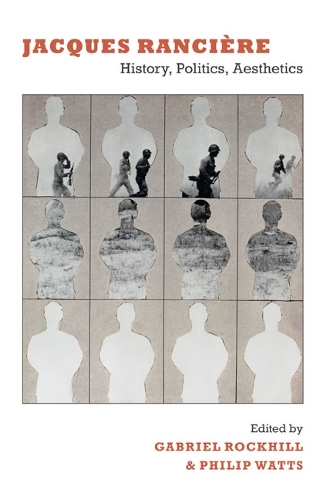
Jacques Rancière :History, Politics, Aesthetics
paperback
Published:
21 August, 2009

Popular Books by Gabriel Rockhill
View All Books by Gabriel Rockhill
Description
The contributors to this collection do not simply elucidate RanciÈre’s project; they also critically respond to it from their own perspectives. They consider the theorist’s engagement with the writing of history, with institutional and narrative constructions of time, and with the ways that individuals and communities can disturb or reconfigure what he has called the “distribution of the sensible.” They examine his unique conception of politics as the disruption of the established distribution of bodies and roles in the social order, and they elucidate his novel account of the relationship between aesthetics and politics by exploring his astute analyses of literature and the visual arts. In the collection’s final essay, RanciÈre addresses some of the questions raised by the other contributors and returns to his early work to provide a retrospective account of the fundamental stakes of his project.
Contributors. Alain Badiou, Étienne Balibar, Bruno Bosteels, Yves Citton, Tom Conley, Solange GuÉnoun, Peter Hallward, Todd May, Eric MÉchoulan, Giuseppina Mecchia, Jean-Luc Nancy, Andrew Parker, Jacques RanciÈre, Gabriel Rockhill, Kristin Ross, James Swenson, Rajeshwari Vallury, Philip Watts
More Details
| Type | Book |
|---|---|
| ISBN13 | 9780822345060 |
| ISBN10 | 0822345064 |
| Number Of Pages | 368 |
| Item Weight | 494 g |
| Publisher / Reseller | Duke University Press |
| Format | paperback |
Media Reviews
“Each chapter in this volume is an engaging and valuable critical engagement with RanciÈre, and, while the book as a whole makes a persuasive case for a thorough and urgent reading of RanciÈre’s work, it is also a useful critical supplement to it.” - Patrick Ffrench, French Studies “This timely collection of essays should finally jump-start the English-speaking conversation about the work of Jacques RanciÈre, one of the most innovative political philosophers now writing. His method of equality, his contrast of a stable ‘police’ order with ‘the political’ as an interruption of that order by those invisible within it, and his idea that both politics and art involve modes of distributing/partitioning the sensible together form a unique constellation of radical political thinking.”-J. M. Bernstein, New School for Social Research “What makes this volume the book that everyone interested in Jacques RanciÈre has to have is its incomparable roster of contributors. RanciÈre himself sets a standard of intellectual seriousness, and the contributors honor him by wrestling strenuously with his thought. They illuminate the trajectory of that thought and the connections between the historian of class and the philosopher of equality, the thinker of politics and the thinker of aesthetics. You can see why RanciÈre is one of the few French thinkers creating an ever greater excitement in North America.”-Bruce Robbins, author of Upward Mobility and the Common Good: Toward a Literary History of the Welfare State “It contextualises RanciÈre's work in a way that one cannot achieve through reading him directly, offering a companion to his core writings. In addition nearly all of the pieces infuse RanciÈre's work with a sense of urgency and timelessness that can often be lost in volumes focused on a single thinker. . . . An impressive and much-needed discussion of RanciÈre’s thought and should prove invaluable to those with an interest in his work.” - Robert Glover (Political Studies Review) “Each chapter in this volume is an engaging and valuable critical engagement with RanciÈre, and, while the book as a whole makes a persuasive case for a thorough and urgent reading of RanciÈre’s work, it is also a useful critical supplement to it.” - Patrick French (French Studies)
Author's Bio
Garbiel Rockhill is an assistant professor of philosophy at Villanova University. He is edited and translated Jacques RanciÈre’s The Politics of Aesthetics. Philip Watts is an associate professor of French at Columbia University. He is the author of Allegories of the Purge: How Literature Responded to the Postwar Trials of Writers and Intellectuals in France.
Philip Watts is Associate Professor and Chair of the Department of French and Romance Philology at Columbia University. He is the author of Allegories of the Purge.