Monsters and Revolutionaries :Colonial Family Romance and Metissage
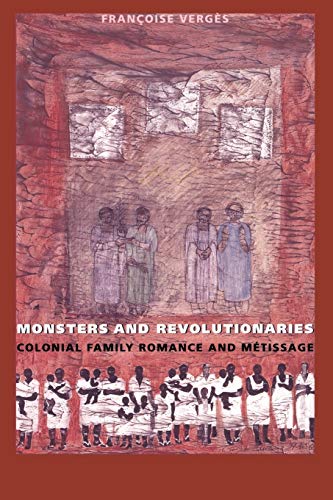
Monsters and Revolutionaries :Colonial Family Romance and Metissage
paperback
Published:
11 June, 1999

Popular Books by Francoise Verges
View All Books by Francoise Verges

Description
Originally settled by sugar plantation owners and their Indian and African slaves following a seventeenth-century French colonial decree, RÉunion abolished slavery in 1848. Because plantation owners continued to import workers from India, Africa, Asia, and Madagascar, the island was defined as a place based on mixed heritages, or mÉtissage. VergÈs reads the relationship between France and the residents of RÉunion as a family romance: France is the seemingly protective mother, La MÈre-Patrie, while the people of RÉunion are seen and see themselves as France’s children. Arguing that the central dynamic in the colonial family romance is that of debt and dependence, Verges explains how the republican ideals of the French Revolution and the Enlightenment are seen as gifts to RÉunion that can never be repaid. This dynamic is complicated by the presence of mÉtissage, a source of anxiety to the colonizer in its refutation of the “purity” of racial bloodlines. For VergÈs, the island’s history of slavery is the key to understanding mÉtissage, the politics of assimilation, constructions of masculinity, and emancipatory discourses on RÉunion.
More Details
| Type | Book |
|---|---|
| ISBN13 | 9780822322948 |
| ISBN10 | 0822322943 |
| Number Of Pages | 416 |
| Item Weight | 717 g |
| Publisher / Reseller | Duke University Press |
| Format | paperback |
Media Reviews
“A brilliant piece of work. . . . Monsters and Revolutionaries promises to be an important intervention in the fields of political history and postcolonial discourse.”-Ali Behdad, University of California at Los Angeles “[VergÈs’s] richly textured exploration of ‘metissage’ as a discursive strategy of identification, assimilation, and resistance is driven by a fluent engagement with concepts drawn from contemporary criticism, history, psychoanalysis, and philosophy and has the broadest implications right across the postcolonial world. A major innovative study that will shape the field.”-Stuart Hall, Emeritus Professor, The Open University and Goldsmith’s College, London
Author's Bio
FranÇoise VergÈs is a Lecturer at the School of European Studies at the University of Sussex. She recently collaborated with Isaac Julien on a film about Frantz Fanon.