Community Without Unity :A Politics of Derridian Extravagance - Post-Contemporary Interventions
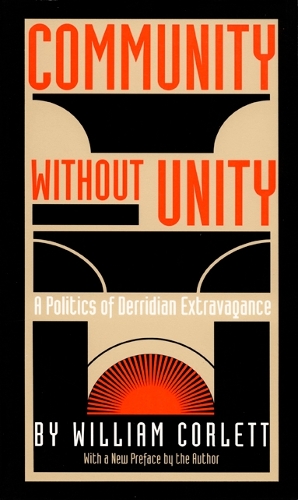
Community Without Unity :A Politics of Derridian Extravagance - Post-Contemporary Interventions
paperback
Published:
30 March, 1993

Popular Books by William Corlett
View All Books by William Corlett







Description
Now available in paperback with a new preface by the author, this award-winning book breaks new ground by challenging traditional concepts of community in political theory. William Corlett brings the diverse (and sometimes contradictory) work of Foucault and Derrida to bear on the thought of Pocock, Burke, Lincoln, and McIntyre, among others, to move beyond the conventional dichotomy of "individual vs. community," arguing instead that community is best advanced within a politics of difference.
More Details
| Type | Book |
|---|---|
| ISBN13 | 9780822313359 |
| ISBN10 | 0822313359 |
| Number Of Pages | 294 |
| Item Weight | 499 g |
| Publisher / Reseller | Duke University Press |
| Format | paperback |
Media Reviews
"In Community Without Unity, Corlett engages those texts which appear to be the most resistant to communitarian uses and finds ways to draw sustenance from them for a defense of community. . . . Corlett thinks creatively about time and temporality and the ways implicit assumptions about time compromise or attentuate explicit themes offered by thinkers such as Foucault and Pocock; demarcates the contemporary literature on community and its criticisms; explores in a very productive way strategies of public reassurance governing the thought of Lincoln and Burke; and examines a complex debate between Foucault and Derrida."-William Connolly, Johns Hopkins University "No one has yet done what Corlett has set out to do. Community Without Unity puts together considerations from traditional political theory with both analyses and methods of Pocock/Skinner, concern with the historical context of discourse, and the philosophy/criticism that we associate with contemporary French work. A very important piece of work."-Tracy B. Strong, University of California, San Diego