Brutal Vision :The Neorealist Body in Postwar Italian Cinema
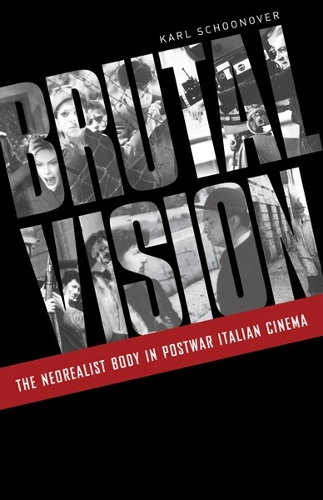
Brutal Vision :The Neorealist Body in Postwar Italian Cinema
paperback
Published:
16 February, 2012

Popular Books by Karl Schoonover
View All Books by Karl Schoonover
Description
Film history identifies Italian neorealism as the exemplar of national cinema, a specifically domestic response to wartime atrocities. Brutal Vision challenges this orthodoxy by arguing that neorealist films-including such classics as Rome, Open City; Paisan; Shoeshine; and Bicycle Thieves-should be understood less as national products and more as complex agents of a postwar reorganization of global politics. For these films, cinema facilitates the liberal humanist sympathy required to usher in a new era of world stability.
In his readings of crucial films and newly discovered documents from the archives of neorealism’s international distribution, Karl Schoonover reveals how these films used images of the imperiled body to reconstitute the concept of the human and to recalibrate the scale of human community. He traces how Italian neorealism emerges from and consolidates the transnational space of the North Atlantic, with scenarios of physical suffering dramatizing the geopolitical stakes of a newly global vision. Here we see how-in their views of injury, torture, and martyrdom-these films propose a new mode of spectating that answers the period’s call for extranational witnesses, makes the imposition of limited sovereignty palatable, and underwrites a new visual politics of liberal compassion that Schoonover calls brutal humanism.
These films redefine moviegoing as a form of political action and place the filmgoer at the center of a postwar geopolitics of international aid. Brutal Vision interrogates the role of neorealism’s famously heart-wrenching scenes in a new global order that requires its citizenry to invest emotionally in large-scale international aid packages, from the Marshall Plan to the liberal charity schemes of NGOs. The book fundamentally revises ideas of cinematic specificity, the human, and geopolitical scale that we inherit from neorealism and its postwar milieu-ideas that continue to set the terms for political filmmaking today.
More Details
| Type | Book |
|---|---|
| ISBN13 | 9780816675555 |
| ISBN10 | 0816675554 |
| Number Of Pages | 328 |
| Item Weight | 1000 g |
| Product Dimensions | 140 x 216 x 23 mm |
| Publisher / Reseller | University of Minnesota Press |
| Format | paperback |
Media Reviews
"If there were ever any doubts about neorealism’s enduring power to generate fine scholarship, Karl Schoonover’s book should lay them to rest. To this most exhaustively studied body of films, the author brings a doubly original perspective-both geopolitically oriented and ethically charged. The result is a theory of spectatorship that goes far toward accounting for neorealism’s pivotal role in the history of film." -Millicent Marcus, author of After Fellini: National Cinema in the Postmodern Age
"While many scholars have struggled to describe the film movement known as neorealism, Brutal Vision advances a different and intellectually productive approach to a vexed subject. The innovative book undertakes a multi-faceted rewriting of post World War II cinema history in a national and international context." -Marcia Landy, author of Stardom, Italian Style: Screen Performance and Personality in Italian Cinema
"This challenging study-with its surprising, persuasive new connections-offers many fresh insights into familiar films. Highly recommended." -CHOICE"Karl Schoonover’s study is a thoroughly worthwhile reconsideration of Italian neorealism. The text accomplishes an always valuable and always challenging objective, namely, that of offering a new critical perspective on a critically well-trodden field. In a seamless blend of theoretical, formal, and archival analysis, Schoonover proposes a future itinerary for scholarly work on neorealism." -Italian Culture
"After reading Brutal Vision, it will not be possible to observe the pain of Italian cinematic bodies without thinking of the geopolitical antes being waged on Italy’s body-politic during the second half of the twentieth century. However, the importance of Schoonover’s book goes well beyond Italian borders. Brutal Vision is a convincing warning against a cinema of pity, and a cautionary tale on the risks of any representational mode founded on the spectacularization and exploitation of suffering. In an age of perpetual humanitarian crisis, Brutal Vision is of utmost urgency and relevancy." -Journal of Italian Cinema & Media
"Schoonover’s study severs neorealism from the dominant debate on its centrality to Italian national identity and film history, and reimagines it on a global plane. Distinctively, however, Schoonovers pursues not a discussion of neorealism’s influence on past or present world film styles, but bringing and international and transnational perspective to bear on its geopolitical context." -Screen
Author's Bio
Karl Schoonover is assistant professor of film studies in the Department of English at Michigan State University. He coedited the anthology Global Art Cinema: New Theories and Histories.