The Environmental Justice Reader :Politics, Poetics, and Pedagogy
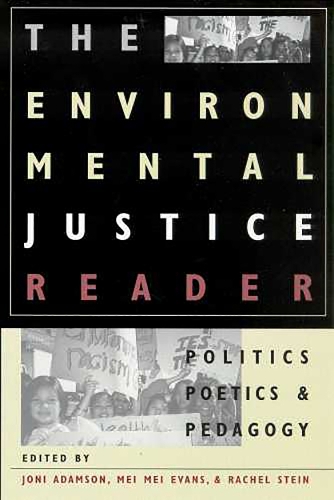
The Environmental Justice Reader :Politics, Poetics, and Pedagogy
paperback
Published:
1 November, 2002

Popular Books by Joni Adamson
View All Books by Joni Adamson
Description
This book examines environmental justice in its social, economic, political, and cultural dimensions in both local and global contexts, with special attention paid to intersections of race, gender, and class inequality. The first book to link political studies, literary analysis, and teaching strategies, it offers a multivocal approach that combines perspectives from organizations such as the Southwest Network for Environmental and Economic Justice and the International Indigenous Treaty Council with the insights of such notable scholars as Devon Peña, Giovanna Di Chiro, and Valerie Kuletz, and also includes a range of newer voices in the field.
This collection approaches environmental justice concerns from diverse geographical, ethnic, and disciplinary perspectives, always viewing environmental issues as integral to problems of social inequality and oppression. It offers new case studies of native Alaskans' protests over radiation poisoning; Hispanos' struggles to protect their land and water rights; Pacific Islanders' resistance to nuclear weapons testing and nuclear waste storage; and the efforts of women employees of maquiladoras to obtain safer living and working environments along the U.S.-Mexican border.
The selections also include cultural analyses of environmental justice arts, such as community art and greening projects in inner-city Baltimore, and literary analyses of writers such as Jimmy Santiago Baca, Linda Hogan, Barbara Neely, Nez Perce orators, Ken Saro-Wiwa, and Karen Yamashita—artists who address issues such as toxicity and cancer, lead poisoning of urban African American communities, and Native American struggles to remove dams and save salmon. The book closes with a section of essays that offer models to teachers hoping to incorporate these issues and texts into their classrooms. By combining this array of perspectives, this book makes the field of environmental justice more accessible to scholars, students, and concerned readers.
More Details
| Type | Book |
|---|---|
| ISBN13 | 9780816522071 |
| ISBN10 | 0816522073 |
| Number Of Pages | 395 |
| Item Weight | 645 g |
| Product Dimensions | 156 x 231 x 23 mm |
| Publisher / Reseller | University of Arizona Press |
| Format | paperback |
Author's Bio
Joni Adamson is Professor of Environmental Humanities in the Department of English and Director of The Environmental Humanities Initiative (EHI) at the Julie Ann Wrigley Global Institute of Sustainability at Arizona State University. Her books have helped to establish and expand the environmental humanities and environmental studies, including most recently, Humanities for the Environment (Routledge 2017); Ecocriticism and Indigenous Studies—Conversations from Earth to Cosmos (Routledge 2016); Keywords for Environmental Studies (New York University Press, 2016), and American Indian Literature, Environmental Justice, and Ecocriticism (University of Arizona Press, 2001). In 2012, she served as President of the Association for the Study Literature and Environment (ASLE).