When you buy a used copy YOU SAVE

0.96Kg of CO2

120 litre(s) of Water

0.0072 Tree(s)

1 book donated to global literacy projects
Dream Hoarders :How the American Upper Middle Class Is Leaving Everyone Else in the Dust, Why That Is a Problem, and What to Do About It
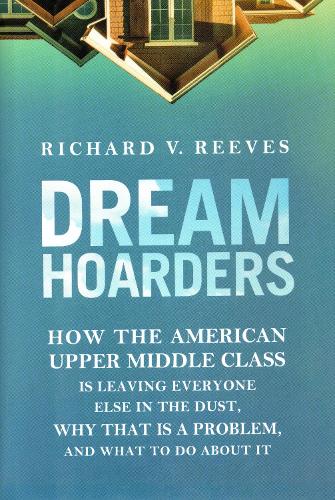
Dream Hoarders :How the American Upper Middle Class Is Leaving Everyone Else in the Dust, Why That Is a Problem, and What to Do About It
hardback
Published:
13 June, 2017
hardback
Published:
13 June, 2017

Standard worldwide delivery by
Thu, July 16 - Tue, July 21
Order within
0

Condition:
USED
$9.87
RRP
$24.07
You save $14.20 (59%)
Available
1
in stock
FREE Returns within 30 days
Popular Books by Richard V. Reeves
View All Books by Richard V. Reeves

Description
America is becoming a class-based society.
It's now conventional wisdom to focus on the excesses of the top 1% - especially the top 0.01% - and how the ultra-rich are hoarding income and wealth while incomes for most other Americans are stagnant. But the more important, and widening, gap in American society is between the upper middle class and everyone else.
Reeves defines the upper middle class as those whose incomes are in the top 20 percent of American society. Income isn't the only way to measure a society, but in a market economy it is crucial because access to money generally determines who gets the best quality education, housing, health care, and other necessary goods and services.
As Reeves shows, the growing separation between the upper middle class and everyone else can be seen in family structure, neighborhoods, attitudes, and lifestyle. Those at the top of the income ladder are becoming more effective at passing on their status to their children, reducing overall social mobility. The result is a fracturing of American society along class lines, not just an economic divide. Upper-middle-class children become upper-middle-class adults.
These trends matter because the separation and perpetuation of the upper middle class corrode prospects for more progressive approaches to policy. Various forms of ""opportunity hoarding"" among the upper middle class make it harder for others to rise up to the top rung. Examples include zoning laws and schooling, occupational licensing, college application procedures, and the allocation of internships. Upper middle class opportunity hoarding, Reeves argues, results in a less competitive economy as well as a less open society.
Inequality is inevitable and can even be good, within limits. But Reeves argues that society can take effective action to reduce opportunity hoarding and thus promote broader opportunity. This fascinating book shows how American society has become the very class-defined society that earlier Americans rebelled against - and what can be done to restore a more equitable society.
It's now conventional wisdom to focus on the excesses of the top 1% - especially the top 0.01% - and how the ultra-rich are hoarding income and wealth while incomes for most other Americans are stagnant. But the more important, and widening, gap in American society is between the upper middle class and everyone else.
Reeves defines the upper middle class as those whose incomes are in the top 20 percent of American society. Income isn't the only way to measure a society, but in a market economy it is crucial because access to money generally determines who gets the best quality education, housing, health care, and other necessary goods and services.
As Reeves shows, the growing separation between the upper middle class and everyone else can be seen in family structure, neighborhoods, attitudes, and lifestyle. Those at the top of the income ladder are becoming more effective at passing on their status to their children, reducing overall social mobility. The result is a fracturing of American society along class lines, not just an economic divide. Upper-middle-class children become upper-middle-class adults.
These trends matter because the separation and perpetuation of the upper middle class corrode prospects for more progressive approaches to policy. Various forms of ""opportunity hoarding"" among the upper middle class make it harder for others to rise up to the top rung. Examples include zoning laws and schooling, occupational licensing, college application procedures, and the allocation of internships. Upper middle class opportunity hoarding, Reeves argues, results in a less competitive economy as well as a less open society.
Inequality is inevitable and can even be good, within limits. But Reeves argues that society can take effective action to reduce opportunity hoarding and thus promote broader opportunity. This fascinating book shows how American society has become the very class-defined society that earlier Americans rebelled against - and what can be done to restore a more equitable society.
More Details
| Type | Book |
|---|---|
| ISBN13 | 9780815729129 |
| ISBN10 | 081572912X |
| Number Of Pages | 240 |
| Item Weight | 517 g |
| Product Dimensions | 161 x 236 x 20 mm |
| Publisher / Reseller | Bloomsbury Publishing Plc |
| Format | hardback |
See More +
Media Reviews
Reeves argues that those in the top 20 percent of the income distribution have become an increasingly isolated class; if the country is to restore the American tradition of upward mobility, this elite will have to pay for it."- New York Times, 2017
Author's Bio
Richard Reeves is a senior fellow in Economic Studies, co-director of the Center on Children and Families, and editor-in-chief of the Social Mobility Memos blog. His research focuses on social mobility, inequality, and family change. Prior to joining Brookings, he was director of strategy to the UK’s Deputy Prime Minister.