Capitalism and a New Social Order :The Republican Vision of the 1790s
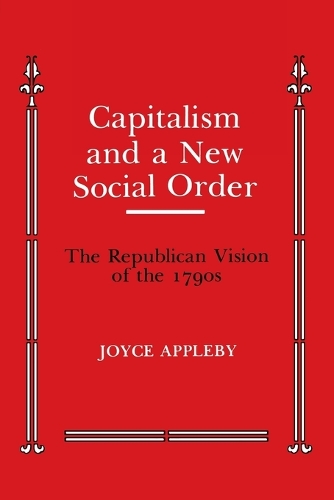
Capitalism and a New Social Order :The Republican Vision of the 1790s
paperback
Published:
1 August, 1984

Popular Books by Joyce Appleby
View All Books by Joyce Appleby
Description
Examines the vision of Jeffersonian Republicans and their impact on early American politics
In 1800 the Jeffersonian Republicans, decisive victors over what they considered elitist Federalism, seized the potential for change in the new American nation. They infused in it their vision of a society of economically progressive, politically equal, and socially liberated individuals. This book examines the fusion of ideas and circumstances which made possible this triumph of America's first popular political movement.
When the Federalists convened in New York to form the "more perfect union" promised by the new United Sates Constitution, they expected to build a strong central government led by the revolutionary members of the old colonial elite. This expectation was dashed by the emergence of a vigorous opposition led by Thomas Jefferson but manned by a new generation of popular politicians: interlopers, émigrés, polemicists—what the Federalists called the "mushroom candidates." They turned the 1790s into an age of passion by raising basic questions about the characters of the American experiment in government.
When the Federalists defenders of traditional European notions of order and authority came under attack, they sought to discredit the radical beliefs of the Jeffersonians. Although the ideas that fueled the Jeffersonian opposition came from several strains of liberal and libertarian thought, it was the specific prospect of an expanding commercial agriculture that gave substance to their conviction that Americans might divorce themselves from the precepts of the past.
Thus, capitalism figured prominently in the Jeffersonian social vision. Aroused by the Federalists' efforts to bind the nation's wealthy citizens to a strengthened central government, the Jeffersonians unified ordinary men in the southern and middle states, mobilizing on the national level the power of the popular vote. Their triumph in 1800 represented a new sectional alliance as well as a potent fusion of morality and materialism.
More Details
| Type | Book |
|---|---|
| ISBN13 | 9780814705834 |
| ISBN10 | 0814705839 |
| Number Of Pages | 122 |
| Item Weight | 172 g |
| Publisher / Reseller | New York University Press |
| Format | paperback |
Author's Bio
Joyce Appleby is Professor of History at the University of California, Los Angeles. She is the author of Economic Thought and Ideology in Seventeenth-Century England which was awarded the 1979 Berkshire book prize.