
0.96Kg of CO2

120 litre(s) of Water

0.0072 Tree(s)

1 book donated to global literacy projects
Understanding Classical Sociology: Marx, Weber, Durkheim
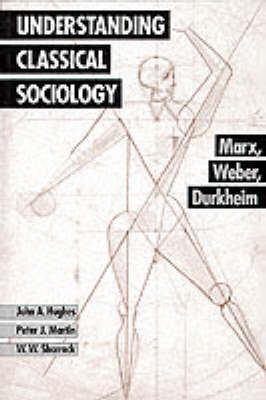
Understanding Classical Sociology: Marx, Weber, Durkheim
paperback
Published:
10 May, 1995


Popular Books by John Hughes
View All Books by John Hughes








Description
More Details
| Type | Book |
|---|---|
| ISBN13 | 9780803986367 |
| ISBN10 | 080398636X |
| Number Of Pages | 240 |
| Item Weight | 459 g |
| Product Dimensions | 161 x 17 x 233 mm |
| Publisher / Reseller | Sage Publications Ltd |
| Format | paperback |
| Edition | 1 |
Media Reviews
`Hughes, Martin, Sharrock set out to write a textbook for undergraduates. Their major aim is to offer a sensitive and faithful interpretation of the pioneers. In this they succeed admirably... make[s] no concessions to those common student demands for four main points about Marx : Hughes et al insist that the great tradition is difficult, that the corpus requires intense effort and reflection. Yet they convey the complexity in an appealing and comprehensible way. There are helpful subheadings, no presumption that readers are familiar with Hegel, Kant and suchlike, and skilful interweaving of biographical material, historical contextualisation and the major ideas of the three giants. For almost 25 years Anthony Giddens's impressive Capitalism and Modern Social Theory has been the required text for classical theory. But that will now change. Less expositional, and more willing to range beyond the original texts, Hughes et al will rapidly, and rightly, become the essential student source. Totally reliable... the authors have produced a book urgently needed by all those charged with introducing students to the classics.... quite indispensable' - The Times Higher Education Supplement
COMPLETE VERSION OF THES REVIEW
`Hughes, Martin, Sharrock set out to write a textbook for undergraduates. Their major aim is to offer a sensitive and faithful interpretations of the pioneers. In this they succeed admirably: the book is made up of an introduction and conclusion set around three chapters, one on Marx, another on Weber and the third on Durkheim. Each chapter is characteristically scholarly but accessible to students. The authors make no concessions to those common student demands for four main points about Marx : Hughes et al insist that the great tradition is difficult, that the corpus requires intense effort and reflection. Yet they manage at the same time to convey the complexity in an appealing and comprehensible way. There are helpful subheadings, no presumption that readers are familiar with Hegel, Kant and suchlike, and skilful interweaving of biographical material, historical contextualisation and the major ideas of the three giants. For almost 25 years Anthony Giddens's impressive Capitalism and Modern Social Theory has been the required text for classical theory. But that will now change. Less expositional, and more willing to range beyond the original texts, Hughes et al will rapidly, and rightly, become the essential student source. Totally reliable... the authors have produced a book urgently needed by all those charged with introducing students to the classics. However, they do more than that. The book also has a mission, one motivated by a revolt against contemporary theory that too often refuses to engage with these dead white males ... Contesting such charges, Hughes and his co-authors have little difficulty in demonstrating that Marx and Weber especially are at the heart of contemporary intellectual life , and that far too much of today's theorising lacks the roots essential to support rigorous thinking. Against much current caricature, they detail how sociology as a discipline was, from its very inception a revolt against the Enlightenment premise of the rational individual actor... Reading Hughes et al one cannot but insist that all debate should be suspended until participants are thoroughly conversant with the classical tradition.... quite indispensable' - The Times Higher Education Supplement
Author's Bio
Wes Sharrock has spent his entire career since 1965 in sociology until his retirement in 2017 at the University of Manchester. His main interests have been in the philosophy of social science and in ethnomethodology, and he has published widely on issues of sociological principle and empirical research in these areas. Wes has explored two central themes--the relevance of fieldwork and an understanding of ordinary language for an understanding of social practice and the respecification of social theory--pursuing them across a huge variety of settings, from ordinary scenes of everyday social life through to complex domains of practical action and reasoning in various academic and industrial work situations. An ethnomethodologist of international reputation, alongside his other contributions, Wes coedited with Mike Lynch the four-volume 2003 Sage collection Harold Garfinkel.