Blackness Visible :Essays on Philosophy and Race
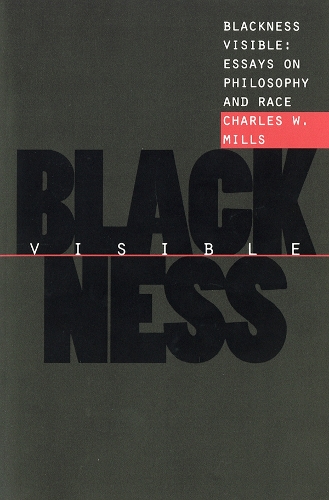
Blackness Visible :Essays on Philosophy and Race
paperback
Published:
7 April, 1998

Popular Books by Charles W. Mills
View All Books by Charles W. Mills







Description
"This is an important collection. Its organizing theme is that by analyzing the metaphysics of race-creating we can understand the importance of political analyses of the racial state. This claim is vital not only for understanding of contemporary racial problems, but also for enriching our understanding of philosophical anthropology."
―Lewis R. Gordon, Brown University
Charles Mills makes visible in the world of mainstream philosophy some of the crucial issues of the black experience. Ralph Ellison's metaphor of black invisibility has special relevance to philosophy, whose demographic and conceptual "whiteness" has long been a source of wonder and complaint to racial minorities. Mills points out the absence of any philosophical narrative theorizing and detailing race's centrality to the recent history of the West, such as feminists have articulated for gender domination. European expansionism in its various forms, Mills contends, generates a social ontology of race that warrants philosophical attention. Through expropriation, settlement, slavery, and colonialism, race comes into existence as simultaneously real and unreal: ontological without being biological, metaphysical without being physical, existential without being essential, shaping one's being without being in one's shape.
His essays explore the contrasting sums of a white and black modernity, examine standpoint epistemology and the metaphysics of racial identity, look at black-Jewish relations and racial conspiracy theories, map the workings of a white-supremacist polity and the contours of a racist moral consciousness, and analyze the presuppositions of Frederick Douglass's famous July 4 prognosis for black political inclusion. Collectively they demonstrate what exciting new philosophical terrain can be opened up once the color line in western philosophy is made visible and addressed.
More Details
| Type | Book |
|---|---|
| ISBN13 | 9780801484711 |
| ISBN10 | 0801484715 |
| Number Of Pages | 272 |
| Item Weight | 454 g |
| Product Dimensions | 152 x 229 x 19 mm |
| Publisher / Reseller | Cornell University Press |
| Format | paperback |
Media Reviews
A collection of eight engagingly written, erudite essays.... There are two major themes here: the first concerns the philosophical professoriate, which is predominately—and, the author contends, dominatingly—white; the second is whether or not race moderates philosophical consciousness. These are deep questions, and in dealing with them, Mills address a broad spectrum of issues: black-Jewish relations, gender (the progress of women vs. blacks), white supremacy, racism, genocide, jurisprudence, and much more. The thought of philosophers and others from ancient times to the present is given incisive analyses, as are epistemological, metaphysical, ethical, political, sociological, and literary considerations. The subject of this book is long overdue for airing. Highly recommended for a variety of pertinent academic and larger public library collections.
(Library Journal)According to Mills... racism is not an aberration of an otherwise nearly ideal American democratic political system but is part of the political fabric, inherited from European imperialists. Mills examines emergent critical race theory and its movement beyond the political and sociological arena to the venerable territory of philosophy. Copiously researched and footnoted, it is an outstanding work that addresses one of the many racial issues of our times.
(Booklist)The effort to make the reality of racism and black life visible is achieved— with a great deal of thought-provoking ideas.
(Ethics)Author's Bio
Charles W. Mills is Distinguished Professor of Philosophy at the University of Illinois, Chicago. He is the author of The Racial Contract, also from Cornell, and From Class to Race: Essays in White Marxism and Black Radicalism.