Transnational Tortillas :Race, Gender, and Shop-Floor Politics in Mexico and the United States
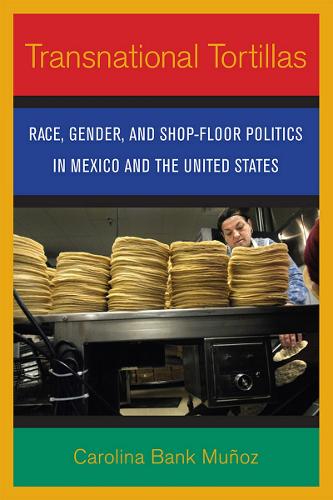
Transnational Tortillas :Race, Gender, and Shop-Floor Politics in Mexico and the United States
paperback
Published:
15 August, 2008

Popular Books by Carolina Bank Munoz
View All Books by Carolina Bank Munoz


Description
This book looks at the flip side of globalization: How does a company from the Global South behave differently when it also produces in the Global North? A Mexican tortilla company, "Tortimundo," has two production facilities within a hundred miles of each other, but on different sides of the U.S.-Mexico border. The workers at the two factories produce the same product with the same technology, but have significantly different work realities. This "global factory" gives Carolina Bank Muñoz an ideal opportunity to reveal how management regimes and company policy on each side of the border apply different strategies to exploit their respective workforces' vulnerabilities.
The author's in-depth ethnographic fieldwork shows that the U.S. factory is characterized by an "immigration regime" and the Mexican factory by a "gender regime." In the California factory, managers use state policy and laws related to immigration status to pit documented and undocumented workers against each other. Undocumented workers are subject to harsher punishment, night-shift work, and lower pay. In the Baja California factory, managers sexually harass women—who make up most of the workforce—and create divisions between light- and dark-skinned women, forcing them to compete for managerial attention, which they understand equates with job security. In describing and analyzing the differences in working conditions between the two plants, Bank Muñoz provides important new insights into how, in a globalized economy, managerial strategies for labor control are determined by the interaction of state policies and labor market conditions with race, gender, and class at the point of production.
Prizes
Winner of Cowinner of the 2009 George Terry Book Award (Acad.
More Details
| Type | Book |
|---|---|
| ISBN13 | 9780801474224 |
| ISBN10 | 0801474221 |
| Number Of Pages | 216 |
| Item Weight | 454 g |
| Product Dimensions | 152 x 229 x 16 mm |
| Publisher / Reseller | Cornell University Press |
| Format | paperback |
Media Reviews
Transnational Tortillas is a case study of two tortilla factories owned by the same company but located across the U.S.-Mexico border from each other. This transnational company organizes labor control differently in the two social and political contexts: The Mexican factory deploys a 'gender regime,' employing young women on the factory floor under the sexist supervision of men; while the U.S. factory uses an 'immigration regime,' employing undocumented Mexican men for the worst jobs and the night shift and Mexican American men (who are U.S. citizens) for the better jobs, some of which are unionized.
- Christine L. Williams (Gender & Society)Carolina Bank Munoz has written a passionate, polemical, but scrupulously objective volume on the intersection of race, gender, and class in two tortilla factories located on opposite sides of the United States–Mexico border in California.
- Julio César Pino (Enterprise & Society)The ethnographic data presented in Transnational Tortillas are impressive. The authorobserved workplace practices in both factory sites and interviewed managers and workers, giving us an insight not only into the mundanities of workplace practice on the production lines of a transnational tortilla firm, but also providing a look at the everyday lives of the workers themselves.
- Juanita Elias (International Studies Review)Ultimately, Bank Munoz has woven together admirably the macro, meso, and micro levels of state policies, labor markets, and workplace dynamics, producing a well-written, accessible, and fascinating account of exploitation and resistance among tortilla workers along the border. Transnational Tortillas should be of considerable value to scholars and students of labor, immigration, and global production.
- Gretchen Purser (Contemporary Sociology)Author's Bio
Carolina Bank Muñoz is Associate Professor of Sociology at Brooklyn College–City University of New York.