Formal Semantics for VHDL - The Springer International Series in Engineering and Computer Science
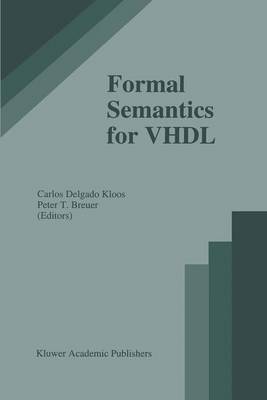
Formal Semantics for VHDL - The Springer International Series in Engineering and Computer Science
hardback
Published:
28 February, 1995
hardback
Published:
28 February, 1995

Standard worldwide delivery by
Tue, August 4 - Fri, August 7
Order within
0
Popular Books by Carlos Delgado Kloos
View All Books by Carlos Delgado Kloos
Description
It is recognized that formal design and verification methods are an important requirement for the attainment of high quality system designs. The field has evolved enormously during the last few years, resulting in the fact that formal design and verification methods are nowadays supported by several tools, both commercial and academic.
If different tools and users are to generate and read the same language then it is necessary that the same semantics is assigned by them to all constructs and elements of the language. The current IEEE standard VHDL language reference manual (LRM) tries to define VHDL as well as possible in a descriptive way, explaining the semantics in English. But rigor and clarity are very hard to maintain in a semantics defined in this way, and that has already given rise to many misconceptions and contradictory interpretations.
Formal Semantics for VHDL is the first book that puts forward a cohesive set of semantics for the VHDL language. The chapters describe several semantics each based on a different underlying formalism: two of them use Petri nets as target language, and two of them higher order logic. Two use functional concepts, and finally another uses the concept of evolving algebras.
Formal Semantics for VHDL is essential reading for researchers in formal methods and can be used as a text for an advanced course on the subject.
If different tools and users are to generate and read the same language then it is necessary that the same semantics is assigned by them to all constructs and elements of the language. The current IEEE standard VHDL language reference manual (LRM) tries to define VHDL as well as possible in a descriptive way, explaining the semantics in English. But rigor and clarity are very hard to maintain in a semantics defined in this way, and that has already given rise to many misconceptions and contradictory interpretations.
Formal Semantics for VHDL is the first book that puts forward a cohesive set of semantics for the VHDL language. The chapters describe several semantics each based on a different underlying formalism: two of them use Petri nets as target language, and two of them higher order logic. Two use functional concepts, and finally another uses the concept of evolving algebras.
Formal Semantics for VHDL is essential reading for researchers in formal methods and can be used as a text for an advanced course on the subject.
More Details
| Type | Book |
|---|---|
| ISBN13 | 9780792395522 |
| ISBN10 | 0792395522 |
| Number Of Pages | 249 |
| Item Weight | 1000 g |
| Publisher / Reseller | Kluwer Academic Publishers |
| Format | hardback |
| Edition | 1995 ed. |
See More +