Design and Analysis of Integrator-Based Log-Domain Filter Circuits - The Springer International Series in Engineering and Computer Science
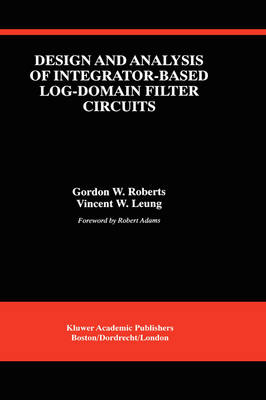
Design and Analysis of Integrator-Based Log-Domain Filter Circuits - The Springer International Series in Engineering and Computer Science
hardback
Published:
30 November, 1999
hardback
Published:
30 November, 1999

Standard worldwide delivery by
Thu, July 30 - Tue, August 4
Order within
0
Popular Books by Gordon W. Roberts
View All Books by Gordon W. Roberts
Description
Design and Analysis of Integrator-Based Log-Domain Filter Circuits deals with the design and analysis of log-domain filter circuits. It describes several synthesis methods that aid the designer in developing bipolar or BiCMOS filter circuits with cut-off frequencies ranging from the low kilohertz range to several hundreds of megahertz. Filter response deviations due to transistor-level nonidealities are systematically analyzed, leading to effective electronic compensation schemes. Numerous examples are provided in the text with measured experimental data from IC prototypes. Design and Analysis of Integrator-Based Log-Domain Filter Circuits is intended for engineers in research or development, as well as advanced-level engineering students. Extensive discussion on filter text metrics should also interest engineers who are responsible for testing high-performance, high-speed analog or mixed-signal products.
More Details
| Type | Book |
|---|---|
| ISBN13 | 9780792386995 |
| ISBN10 | 079238699X |
| Number Of Pages | 254 |
| Item Weight | 1000 g |
| Publisher / Reseller | Kluwer Academic Publishers |
| Format | hardback |
| Edition | 2000 ed. |
See More +
Media Reviews
From the foreword:
`The bipolar transistor has a remarkable characteristic that makes it unique as a circuit design element; it displays an exponential relationship between collector current and base-to-emitter voltage that is highly accurate over an extremely wide range of currents. This conformance to a mathematical law opens up numerous possibilities for analog signal processing. Log filters represent one of the most interesting applications of this exponential relationship.'
Robert Adams, Analog Devices