The Pheasant Cap Master (He guan zi) :A Rhetorical Reading - SUNY series in Chinese Philosophy and Culture
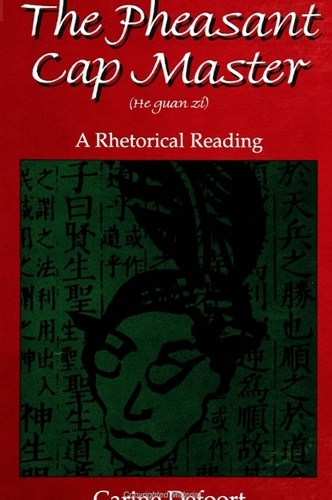
The Pheasant Cap Master (He guan zi) :A Rhetorical Reading - SUNY series in Chinese Philosophy and Culture
paperback
Published:
1 November, 1996

Popular Books by Carine Defoort
View All Books by Carine Defoort
Description
More Details
| Type | Book |
|---|---|
| ISBN13 | 9780791430743 |
| ISBN10 | 079143074X |
| Number Of Pages | 376 |
| Item Weight | 526 g |
| Product Dimensions | 152 x 229 x 1 mm |
| Publisher / Reseller | State University of New York Press |
| Format | paperback |
Media Reviews
"This is an exceptionally thorough, clear, and well-structured account of an important early Chinese text that has been largely overlooked by most scholars because of doubts about its authenticity and difficulties with its textual integrity—issues now largely clarified by this study.
"The author's approach is particularly interesting and illuminating; the focusThere is not only on what the He guan zi says, but how things are said, and how language is used in argumentation." — John S. Major, author of Heaven and Earth in Early Han Thought
"The He guan zi is of considerable importance in ascertaining the nature of the intellectual world of the late Warring States period, but it has been greatly under studied and under appreciated because of its unclear intellectual filiation, its textual complexities, and its questionable authenticity. Defoort's book makes great strides toward clearing up these various confusions that have stood in the way of fully appreciating this text for centuries. " — H. D. Roth, Brown University
"Defoort's analysis of the text is very sophisticated, making a convincing argument that we have inappropriate expectations in approaching a Chinese text. That is, in a tradition such as our own, there is tension between philosophy and rhetoric that has, with few exceptions, been resolved in favor of the philosophical. This being the case, we approach a text with logical rather than rhetorical expectations, and find a text 'incoherent' if it does not satisfy these demands. Without the philosophical/rhetorical tension, a Chinese text must be entertained in a very different way." — Roger T. Ames, University of Hawaii
Author's Bio
Carine Defoort is Associate Professor in the Department of Oriental Studies, Sinology at Katholieke Universiteit Leuven in Belgium.