Afrasia :A Tale of Two Continents
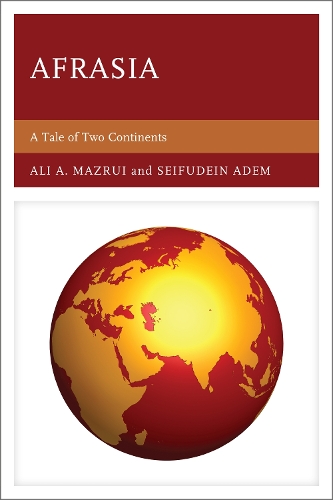
Afrasia :A Tale of Two Continents
paperback
Published:
2 May, 2013

Popular Books by Seifudein Adem
View All Books by Seifudein Adem



Description
More Details
| Type | Book |
|---|---|
| ISBN13 | 9780761847717 |
| ISBN10 | 0761847715 |
| Number Of Pages | 436 |
| Item Weight | 608 g |
| Product Dimensions | 153 x 226 x 31 mm |
| Publisher / Reseller | University Press of America |
| Format | paperback |
Media Reviews
This is not, strictly speaking, a ‘Tale of Two Continents’ so much as a number of eclectic offerings about parts of Africa and parts of Asia, crossing time, space, races, and cultures. Indeed, it is rewarding precisely for this reason, and for trying to move scholarship forward in ways that, building on broad historical foundations, endeavour to be fresh, critical, and self-reflexive.The book offers a colourfully presented and decidedly mixed, wide-ranging menu, rather than a sustained argument. . . .Afrasia: A Tale of Two Continents will likely benefit those with some familiarity with its subject areas more than those new to, or starting to engage, its core themes. Overall, it offers an enlivening and unconventional contribution, with the potential to catalyse further work in positive ways. Its critical invocation of the need for a discourse about discourse on Africa’s relations with China, Japan, or India points the way to promising scholarly directions, including, as Ngugi wa Thiong’o would like to see, ways that go beyond the age of European empires and post-colonial influence. This can only be a good thing, especially if it catalyses further such insightful works by leading African scholars that properly enrich and advance these avenues of enquiry. * E-International Relations *
In a volume of over four hundred pages Afrasia: A Tale of Two Continents offers many interesting questions to ponder. The chapters are glimpses, reflections, and in some cases lengthy discussions on many issues[.] . . .Afrasia: A Tale of Two Continents contain sufficient thoughts, arguments, and references for further investigation of the layered complexities of Afro–Asian relations. [It will] certainly will generate debates and induce more critical research. * African Studies Review *
Author's Bio
Ali A. Mazrui is Albert Schweitzer Professor in the Humanities at the State University of New York in Binghamton, New York. He has been officially received by the heads of state of India and China and has served as chancellor of Jomo Kenyatta University of Agriculture and Technology. Dr. Mazrui has also served as president of the Association of Muslim Social Scientists of North America. His research interests include the soft power of culture and religion in the Middle East and South Asia and the years of ideological power in Mao’s China.
Seifudein Adem is associate professor of political science at the State University of New York in Binghamton, New York. He has taught at universities in Ethiopia, Japan, and the United States. Dr. Adem has published widely on the political economy of Africa-China relations and Africa-Japan relations.