Against the Grain :The Vayda Tradition in Human Ecology and Ecological Anthropology
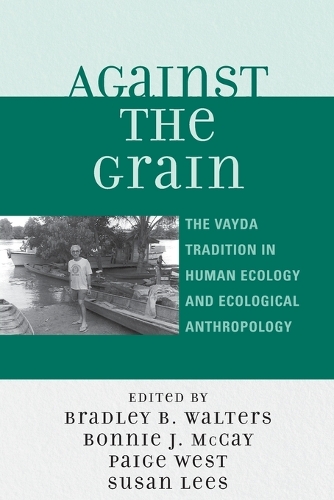
Against the Grain :The Vayda Tradition in Human Ecology and Ecological Anthropology
paperback
Published:
16 December, 2008

Popular Books by Bradley B. Walters
View All Books by Bradley B. Walters
Description
More Details
| Type | Book |
|---|---|
| ISBN13 | 9780759111738 |
| ISBN10 | 0759111731 |
| Number Of Pages | 392 |
| Item Weight | 617 g |
| Product Dimensions | 154 x 230 x 23 mm |
| Publisher / Reseller | AltaMira Press |
| Format | paperback |
Media Reviews
Against the Grain provides an admirable survey of Vayda's career, shows some interesting extensions and applications of his ideas, and provides an elaborated critique of contrasting views in human ecology and ecological anthropology. I recommend this book to all who explore human environment relationships and those economic botanists who wish to explore why questions in their study of plant use. * Economic Botany *
This is an excellent volume. Its strength lies in providing an intellectual history of an eminent anthropologist and a partial understanding of his influence on scholars and on anthropological theory, methodology, and practice over a considerable number of years. * Current Anthropology *
. . . An excellent volume . . . Its strength lies in providing an intellectual history of an eminent anthropologist and a partial understanding of his influence on scholars and on anthropological theory, methodology, and practice over a considerable number of years. * Current Anthropology *
The volume is a resource that is likely to be referenced frequently by researchers and individual chapters will provide excellent reading material for courses in ecological anthropology. * Human Ecology *
In a world of enormous socio-environmental complexity, perhaps the most laudable intellectual position is one of rigorous humility. The works in this volume are compelling tributes to such an approach, providing sober, meticulous, and powerful explanations, all of which urge against over-simple generalization and a priori assumptions, which too often blur our understanding of the environmental changes around us. The Vayda tradition is alive and well, and we would all do well to heed its lessons. -- Paul Robbins, University of Wisconsin–Madison
Against the Grain provides an admirable survey of Vayda's career, shows some interesting extensions and applications of his ideas, and provides an elaborated critique of contrasting views in human ecology and ecological anthropology. I recommend this book to all who explore human environment relationships and those economic botanists who wish to explore "why" questions in their study of plant use. * Economic Botany *
Author's Bio
Bradley B. Walters is associate professor of geography & environment at Mount Allison University in Sackville, New Brunswick. Bonnie J. McCay is Board of Governors Distinguished Service Professor at Rutgers, the State University of New Jersey, in the Department of Human Ecology. Paige West is assistant professor of anthropology at Barnard College, New York. Susan Lees is professor emerita of anthropology at Hunter College and the Graduate Center of the City University of New York.