Modernities, Class, and the Contradictions of Globalization :The Anthropology of Global Systems
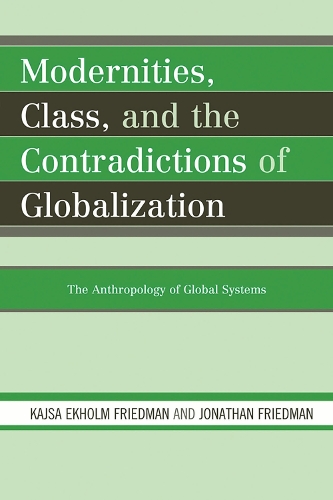
Modernities, Class, and the Contradictions of Globalization :The Anthropology of Global Systems
hardback
Published:
9 June, 2008

Popular Books by Jonathan Friedman
View All Books by Jonathan Friedman







Description
More Details
| Type | Book |
|---|---|
| ISBN13 | 9780759111127 |
| ISBN10 | 075911112X |
| Number Of Pages | 330 |
| Item Weight | 644 g |
| Product Dimensions | 160 x 239 x 26 mm |
| Publisher / Reseller | AltaMira Press |
| Format | hardback |
Media Reviews
Weaving together a provocative and innovative approach to the global process of social reproduction, Kajsa Ekholm Friedman and Jonathan Friedman move beyond glib and fashionable globalization-speak and identity-talk. In a series of broad-ranging essays, they challenge us to rethink the logic of modernity and issues of political economy, class, cultural authenticity, and representation. -- Nina Glick Schiller, University of Manchester
Bacall and Bogart typify a particular time in film. Ekholm Friedman and Friedman define a particular time in anthropology. Bacall and Bogart did it with grace; Ekholm Friedman and Friedman do it with disciplinary elegance. What they do is to rethink anthropology, specifically by using global anthropology to explain the emergence and dynamics of the modern world. In Modernities, Class, and the Contradictions of Globalization, the second volume of their monumental The Anthropology of Global Systems, the authors introduce concepts and theoretical debates that have characterized different attempts to understand the global. Ekholm Friedman and Friedman help us understand the modern world's changing ethnographic landscape, forms of political order, and diverse modes of discourse. They are the Bacall and Bogart of systemic globalization. -- Stephen Reyna, University of Manchester
Here, at last, is a book that challenges conventional wisdom in the social sciences concerning globalization. The authors conceive of globalization (and thus the destruction it has sown) as a systemic global process of fragmentation caused by such forces as the decline of Western political economies and the movement of capital into new centers of power. They brilliantly question many public 'solutions' to the problems of globalization, arguing that they are often merely new ways of dressing up old ideas that never did address sufficiently the plight of those caught in the destructive web of globalizing forces. This volume is a major work that will dispel complacency, inspire discussion, and, one hopes, lead to a re-imagining of new solutions to global problems. -- Bruce Kapferer, University of Bergen
Author's Bio
Kajsa Ekholm Friedman is professor in the Department of Social Anthropology at Lund University, Sweden. Jonathan Friedman is directeur d'études at the Ecole des Hautes Etudes en Sciences Sociales, in Paris, and professor of social anthropology at Lund University.