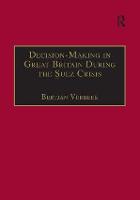
Decision-Making in Great Britain During the Suez Crisis :Small Groups and a Persistent Leader

Decision-Making in Great Britain During the Suez Crisis :Small Groups and a Persistent Leader
hardback
Published:
28 September, 2003

Popular Books by Bertjan Verbeek
View All Books by Bertjan Verbeek

Description
More Details
| Type | Book |
|---|---|
| ISBN13 | 9780754632535 |
| ISBN10 | 0754632539 |
| Number Of Pages | 208 |
| Item Weight | 540 g |
| Publisher / Reseller | Taylor & Francis Ltd |
| Format | hardback |
Media Reviews
'Verbeek’s research overcomes an often noted difficulty that theories of foreign policy decision making require data that is seldom available. He carefully reconstructs the decisions of the British inner cabinet during the Suez Canal Crisis of 1956 and applies insights from the study of small group behavior. The result is a book that not only contributes to our theoretical knowledge but also offers explanations for the remarkable actions of Prime Minister Anthony Eden and his close associates during a critical international episode. It makes for fascinating reading.' Charles F. Hermann, Texas A&M University , USA 'This is a prime example of political psychology at its best: tracing the role of individuals, groups and bureaucratic organisations in a complex political decision-making process. Verbeek successfully explains why British policymakers pursued such a foolish course of action during the Suez crisis by carefully examining their worldviews, their interactions as a group, and the impact of bureaucratic politics in the British foreign and defense policy arena. This thorough yet concise and well-written study compares, contrasts and weighs the explanatory potential of classic theories of foreign policy decision-making. It is a must for all students of foreign policy analysis, international relations and political psychology.' Paul 't Hart, Leiden University, Netherlands and Swedish Defence College, Sweden 'Although much studied, the Suez Crisis has long remained a puzzle. This fascinating and carefully researched volume by Bertjan Verbeek throws new light on how small group decision-making shaped a costly outcome that few anticipated and fewer desired.' Michael W. Doyle, Princeton University, USA and author of Ways of War and Peace '...a notably superior addition to the fast-growing corpus of works on and around Britain's luckless stab at regime change and pre-emptive self-defence in the Middle East of 1956.' International Affairs 'Verbeek...gives the r
Author's Bio
Bertjan Verbeek is Associate Professor of International Relations within the Department of Political Science at the Nijmegen School of Management, University of Nijmegen, The Netherlands.