Readings :Acts of Close Reading in Literary Theory
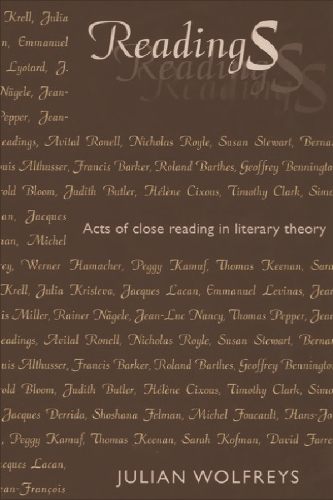
Readings :Acts of Close Reading in Literary Theory
paperback
Published:
27 May, 2000

Popular Books by Julian Wolfreys
View All Books by Julian Wolfreys
Description
More Details
| Type | Book |
|---|---|
| ISBN13 | 9780748613526 |
| ISBN10 | 0748613528 |
| Number Of Pages | 192 |
| Item Weight | 294 g |
| Publisher / Reseller | Edinburgh University Press |
| Format | paperback |
Media Reviews
Julian Wolfreys writes like an accessible Derrida. His achievement in Readings is a remarkable illumination of the often impenetrable relation of reading to questions of responsibility, guilt, political choice, democracy, resistance and performativity. There are few critics who combine complexity and exposition with such ease, or who can weave such an efficient summary of contemporary debates on the ethics of reading into such a subtle performance of their own as Wolfreys. -- Mark Currie, University of Westminster Somehow - I wish I knew how he did it - Julian Wolfreys manages to write on the most intricate and subtle topics with something approaching perfect lucidity. He is clear; he is funny; he is right. This gentle and brilliant exploration of what reading can mean and what it can do is conducted with the kind of assurance and ease one associates with Maria Callas, with Pele, with Groucho Marx: a great pro working with such lubricated grace it looks like play. I certainly have never learned so much from a book, nor had such a fine time doing it. -- James R. Kincaid, Aerol Arnold Professor of English, University of Southern California I think that Readings is a very welcome and even urgent book. A fine pedagogical sense allows Wolfreys to represent clearly and elegantly rather obscure or difficult texts building slowly a critical mosaic through a collage of exemplary readings. Julian Wolfreys is a sharp and astute literary critic who remains aware that literature cannot be reduced to context, history, or philosophy. -- Jean-Michel Rabate, Department of English, University of Pennsylvania This elegantly written essay starts from the premise that reading is never innocent and in a series of encounters with a variety of well-chosen texts on the subject of reading demonstrates that deconstructive criticism is still a force to be reckoned with. -- K.M. Newton, Professor of English, University of Dundee Through his explorations of such illuminating concepts as 'reading to excess', 'infectious reading', and the 'impossible responsibility' inherent in our various acts of textual consumption, Wolfreys challenges us to reconsider the conventional parameters and assumptions that mark so many of our reading practices. -- Professor Kenneth Womack, Pennsylvania State University Julian Wolfreys writes like an accessible Derrida. His achievement in Readings is a remarkable illumination of the often impenetrable relation of reading to questions of responsibility, guilt, political choice, democracy, resistance and performativity. There are few critics who combine complexity and exposition with such ease, or who can weave such an efficient summary of contemporary debates on the ethics of reading into such a subtle performance of their own as Wolfreys. Somehow - I wish I knew how he did it - Julian Wolfreys manages to write on the most intricate and subtle topics with something approaching perfect lucidity. He is clear; he is funny; he is right. This gentle and brilliant exploration of what reading can mean and what it can do is conducted with the kind of assurance and ease one associates with Maria Callas, with Pele, with Groucho Marx: a great pro working with such lubricated grace it looks like play. I certainly have never learned so much from a book, nor had such a fine time doing it. I think that Readings is a very welcome and even urgent book. A fine pedagogical sense allows Wolfreys to represent clearly and elegantly rather obscure or difficult texts building slowly a critical mosaic through a collage of exemplary readings. Julian Wolfreys is a sharp and astute literary critic who remains aware that literature cannot be reduced to context, history, or philosophy. This elegantly written essay starts from the premise that reading is never innocent and in a series of encounters with a variety of well-chosen texts on the subject of reading demonstrates that deconstructive criticism is still a force to be reckoned with. Through his explorations of such illuminating concepts as 'reading to excess', 'infectious reading', and the 'impossible responsibility' inherent in our various acts of textual consumption, Wolfreys challenges us to reconsider the conventional parameters and assumptions that mark so many of our reading practices.
Author's Bio
Julian Wolfeys is Professor of English Literature at the University of Portsmouth, where he is also Director of the Centre for Studies in Literature. He is author and editor of more than 40 books on nineteenth- and twentieth-century English literature and literary theory. Most recently he has published Dickens’s London and The Derrida Wordbook, both with Edinburgh University Press. He recently published his first novel, Silent Music.