The Growth of Non-Western Cities :Primary and Secondary Urban Networking, c. 900–1900 - Comparative Urban Studies
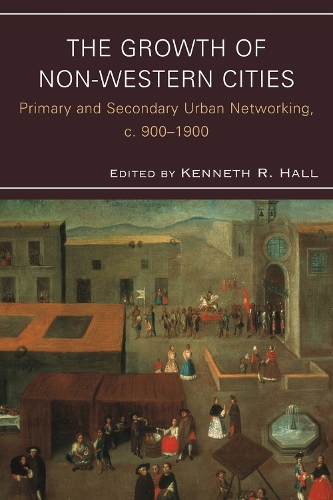
The Growth of Non-Western Cities :Primary and Secondary Urban Networking, c. 900–1900 - Comparative Urban Studies
paperback
Published:
8 August, 2011

Popular Books by Kenneth R. Hall
View All Books by Kenneth R. Hall


Description
More Details
| Type | Book |
|---|---|
| ISBN13 | 9780739149997 |
| ISBN10 | 0739149997 |
| Number Of Pages | 358 |
| Item Weight | 576 g |
| Product Dimensions | 157 x 232 x 21 mm |
| Publisher / Reseller | Bloomsbury Publishing Plc |
| Format | paperback |
Media Reviews
From the China Sea to the Persian Gulf—with excursions into Africa, Eastern Europe, and North America—the authors in this collection capture a world in motion. Through their eyes we see traders, government officials, and religious functionaries moving across shifting networks of commerce, culture, and faith—in the process shaping a world of cities that thrives far from the more familiar landmarks of western urbanism. -- Eric Sandweiss, Indiana University
An interesting and wide-ranging study. . . . This book takes on an understudied and under-theorized topic and makes it accessible to the general reader. The comparative dimensions of the book will surely be important to a number of scholars working in different fields across the globe. -- Eric Tagliacozzo, Cornell University
This collection brings together wide-ranging, creative scholarship that foregrounds ground-level connections across cities and cultures. Its fresh ecologies of knowledge provide stimulating new views of flows of peoples and ideas that help us rethink the construction of world networks without the blinders of a singular "Western gaze." Readers will appreciate the attention to rich texts and visual data and the connections that resonate across millennia and continents. The essays are especially stimulating in remapping Asian cities from grassroots and local hierarchies but have much wider implications for the present and future as well as recasting our gaze on Western urban networks as well. -- Gary W. McDonogh, Bryn Mawr College
These 12 essays derive from a 2009 conference hosted by editor Hall at Ball State University. He challenged participants to employ new social scientific models of human networking to explore historical changes in non-Western urban systems. The essays present research on small cities in East and Southeast Asia, the Indian Ocean basin, Africa, Mexico, and the Ottoman Balkans that highlights internal local agency rather than external imperial pressures. The authors analyze documents and artifacts that elicit how local communities conceptualized their relationships with distant trading partners or hubs of power, and how they reconceptualized themselves as waves of migration, emerging economic opportunities, missionary visions, shifts in political boundaries, and, in the final essays, modernization reconfigured local social relations and ethnic interactions. The essays are informed by postcolonial theories applied to precolonial histories, but the case studies successfully put historical faces on the overarching theoretical framework. Europeans play peripheral roles in these essays, yet students of premodern European urban history have much to learn from this work. Figurative models of urban networks, maps, and photographs of archaeological sites and contemporary imagery enrich the text. Essay-specific endnotes. Summing Up: Recommended. Graduate students, faculty. * Choice Reviews *
Author's Bio
Kenneth R. Hall is professor of History at Ball State University. His most recent books are A History of Early Southeast Asia: Maritime Trade and Cultural Development; New Perspectives in the History and Historiography of Southeast Asia, Continuing Explorations (co-editor with Michael Aung-Thwin, 2011); Secondary Cities and Urban Networking in the Indian Ocean Realm, c. 1400-1800 (editor, 2008); and Structural Change in Early South India (editor, 2001/2005).