Whatever Happened to Class? :Reflections from South Asia
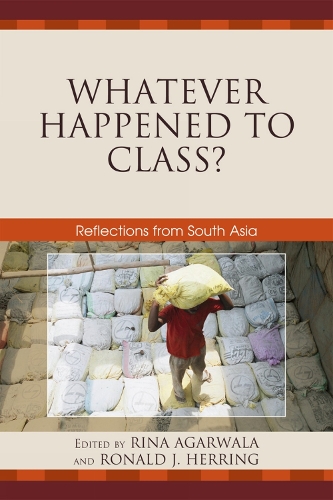
Whatever Happened to Class? :Reflections from South Asia
paperback
Published:
23 October, 2008

Popular Books by Rina Agarwala
View All Books by Rina Agarwala

Description
Class explains much in the differentiation of life chances and political dynamics in South Asia; scholarship from the region contributed much to class analysis. Yet class has lost its previous centrality as a way of understanding the world and how it changes. This outcome is puzzling; new configurations of global economic forces and policy have widened gaps between classes and across sectors and regions, altered people's relations to production, and produced new state-citizen relations. Does market triumphalism or increased salience of identity politics render class irrelevant? Has rapid growth in aggregate wealth obviated long-standing questions of inequality and poverty?
Explanations for what happened to class vary, from intellectual fads to global transformations of interests. The authors ask what is lost in the move away from class, and what South Asian experiences tell us about the limits of class analysis. Empirical chapters examine formal and informal-sector labor, social movements against genetic engineering, and politics of the "new middle class." A unifying analytical concern is specifying conditions under which interests of those disadvantaged by class systems are immobilized, diffused, co-opted—or autonomously recognized and acted upon politically: the problematic transition of classes in themselves to classes for themselves.
More Details
| Type | Book |
|---|---|
| ISBN13 | 9780739132562 |
| ISBN10 | 0739132563 |
| Number Of Pages | 228 |
| Item Weight | 340 g |
| Product Dimensions | 154 x 229 x 17 mm |
| Publisher / Reseller | Bloomsbury Publishing Plc |
| Format | paperback |
Media Reviews
This terrific, sharply focused book illuminates how very much we have lost by dismissing class analysis—and why. From workers to middle classes to migrants, and from social science to natural science, these distinguished scholars show us what was right before our eyes if only we would see it. -- Marc Blecher, Oberlin College
This important book revives the concept of class to illuminate the dramatic changes occurring in contemporary South Asian societies. Its intriguing insights make it essential reading for anyone interested in understanding the social dynamics of the region and the continuing relevance of class. -- John Echeverri-Gent, University of Virginia
This is an outstanding volume, a must read for both friends and foes of class analysis. The contributions are sophisticated, sober, and timely. -- Atul Kohli, Princeton University
South Asian capitalism fragments the political organization of labour while the working class multiplies; it consolidates the organization of capital while pathways to accumulation diversify. The willful ignoring or destruction of class analysis obscures our understanding of the complex class and non-class dynamics of capitalism. Agarwala, Herring, and their colleagues are to be congratulated for bringing class back in. -- Barbara Harriss-White, Oxford University
This book shows, contrary to recent social science claims, that smart class analysis is not only possible but still carries a powerful explanatory punch. Refusing to shy away from the difficulties of class theory, and carefully considering the naysayers, the contributors continually push readers onto promising new turf. That these lessons from South Asia also apply to other non-core countries is what makes the book valuable to a wide body of students and researchers. -- David Ost, Hobart and William Smith Colleges
Author's Bio
Rina Agarwala is an assistant professor in the department of sociology at Johns Hopkins University. Ronald J. Herring teaches political economy and political ecology at Cornell University.