Making a Difference :A Comparative View of the Role of the Internet in Election Politics
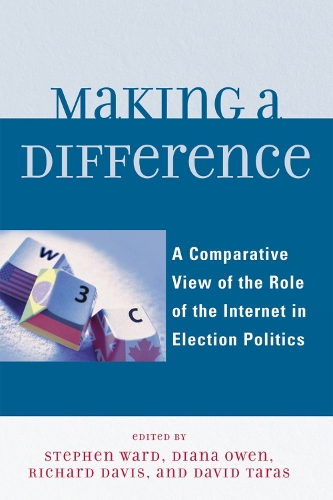
Making a Difference :A Comparative View of the Role of the Internet in Election Politics
paperback
Published:
13 March, 2008

Popular Books by Richard Davis
View All Books by Richard Davis





Description
This book is a cross-national analysis of the role of the internet in national electoral campaigns. It covers an array of electoral and party systems throughout the globe from parliamentary to presidential, party-based to candidate-oriented, multi-party to two-party, and stable party system to dynamic party system. It takes a look at three groups of nations with varying levels of Internet access—those where internet usage is common across demographic groups, those where usage has reached significant levels but not widespread penetration, and those where internet access is still limited to a small elite.
Each chapter is a study of a particular nation, focusing on its electoral and party systems, the accessibility of the Internet to the population, the nature of candidate/party usage, and the effects of the internet on the conduct of campaigns. By reviewing the findings from these studies, Making a Difference draws conclusions about exactly how the internet influences electoral politics.
More Details
| Type | Book |
|---|---|
| ISBN13 | 9780739121016 |
| ISBN10 | 0739121014 |
| Number Of Pages | 316 |
| Item Weight | 476 g |
| Product Dimensions | 158 x 229 x 23 mm |
| Publisher / Reseller | Bloomsbury Publishing Plc |
| Format | paperback |
Media Reviews
There are two ways to explain the impact of the Internet on democratic process. One describes the Internet's role in specific situations. The second attempts to define the concepts that help us better understand this role. These collected studies do bothand do them very well. The volume allows the reader to visualize how and where the integration of the Internet into campaigns and elections has succeeded or failed and, even more importantly, to begin to comprehend why. The breadth of cases is valuable and expansive, representing countries and regions that have not often been studied. Each country case delves deeply into the respective campaign and election systems, providing an engaging and ultimately powerful snapshot of the contemporary state of the impact of technological diffusion on democratic process.. -- Kenneth Rogerson, Duke University
This book is an intellectual feast for all serious Internet scholars, especially comparativists. It describes and analyzes Internet coverage of election campaigning in twelve countries in the Americas, Asia, and Australia. A wide array of political communication issues take on new life when viewed from the perspectives of these politically and culturally diverse nations. -- Doris Graber, professor of political science and communication at the University of Illinois-Chicago and editor emeritus ofPolitical Communica
The Internet is a driving force in globalization—but as this thought-provoking anthology discloses, that doesn't mean internet-campaigning is the same everywhere. Explore the online politics of a dozen nations with the estimable tour guides of Making a Difference. You'll be invigorated by the voyage. -- Michael Cornfield, vice president of research and media strategy for 720 Strategies, and adjunct professor in political management at the George Wa
The analyses are generally competent and interesting, and the editors draw significant comparative conclusions from them. Recommended. * Choice Reviews *
A much-needed volume examining the Internet in context across political systems. The contributors make a big stride forward in identifying how properties of technology interact with features of political structure in processes of stasis and change. -- Bruce Bimber, author of Information and American Democracy: Technology in the Evolution of Political Power (Cambridge University Press, 2003),
There are two ways to explain the impact of the Internet on democratic process. One describes the Internet's role in specific situations. The second attempts to define the concepts that help us better understand this role. These collected studies do both and do them very well. The volume allows the reader to visualize how and where the integration of the Internet into campaigns and elections has succeeded or failed and, even more importantly, to begin to comprehend why.
The breadth of cases is valuable and expansive, representing countries and regions that have not often been studied. Each country case delves deeply into the respective campaign and election systems, providing an engaging and ultimately powerful snapshot of the contemporary state of the impact of technological diffusion on democratic process.
Author's Bio
Richard Davis is professor of political science at Brigham Young University.
Diana Owen is associate professor of political science and director of American studies at Georgetown University.
David Taras is professor of political science at the University of Calgary.
Stephen Ward is a senior lecturer in politics at the European Studies Research Institute, University of Salford, England.