Why Trust Science? - The University Center for Human Values Series
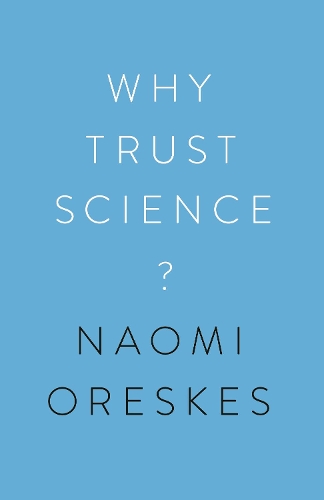
Why Trust Science? - The University Center for Human Values Series
hardback
Published:
25 October, 2019

Popular Books by Naomi Oreskes
View All Books by Naomi Oreskes
Description
Why the social character of scientific knowledge makes it trustworthy
Do doctors really know what they are talking about when they tell us vaccines are safe? Should we take climate experts at their word when they warn us about the perils of global warming? Why should we trust science when our own politicians don't? In this landmark book, Naomi Oreskes offers a bold and compelling defense of science, revealing why the social character of scientific knowledge is its greatest strength—and the greatest reason we can trust it.
Tracing the history and philosophy of science from the late nineteenth century to today, Oreskes explains that, contrary to popular belief, there is no single scientific method. Rather, the trustworthiness of scientific claims derives from the social process by which they are rigorously vetted. This process is not perfect—nothing ever is when humans are involved—but she draws vital lessons from cases where scientists got it wrong. Oreskes shows how consensus is a crucial indicator of when a scientific matter has been settled, and when the knowledge produced is likely to be trustworthy.
Based on the Tanner Lectures on Human Values at Princeton University, this timely and provocative book features critical responses by climate experts Ottmar Edenhofer and Martin Kowarsch, political scientist Jon Krosnick, philosopher of science Marc Lange, and science historian Susan Lindee, as well as a foreword by political theorist Stephen Macedo.
More Details
| Type | Book |
|---|---|
| ISBN13 | 9780691179001 |
| ISBN10 | 069117900X |
| Number Of Pages | 376 |
| Item Weight | 1000 g |
| Publisher / Reseller | Princeton University Press |
| Format | hardback |
Media Reviews
"New Zealand Listener's Best Book of 2019"
"One of FiveBooks' Best Climate Books of 2019"
"Oreskes joins a distinguished line of thinkers who explain why we should trust the findings of the scientific community . . . [and] clearly reminds readers that science has consistently brought home the bacon." * Kirkus Reviews *
"Why Trust Science? is an optimistic analysis of the opportunities that exist for enhancing public trust in science. This book should be mandatory reading for anyone who is part of the scientific endeavor."---Elisabeth Gilmore, Science
"[A] fascinating new book . . . in a field with few reasons to be cheerful, it is both enlightening and encouraging. Once we begin to understand the size of the chasm that separates science’s outsiders and insiders, as Oreskes clearly does, we can at least start to design a bridge."---Michael Brooks, New Scientist
"Two features of science, [Oreskes] claims, account for its trustworthiness: its ‘sustained engagement with the world’ together with ‘its social character.’ Her emphasis on the second feature may surprise readers used to thinking of science as a tidy epistemic enterprise neatly insulated from social influence, but this view emerges clearly from her sober review of studies of science by historians, philosophers, sociologists, and anthropologists during the past half century."---Philip Kitcher, Boston Review
"A compelling argument in favour of experts."---Hettie O’Brien, New Statesman
"For both its evidence-based rigor and striking honesty, Why Trust Science? by Naomi Oreskes should be required reading for everyone in scholarly communications. Addressing the broadest view of science possible — from the experimental to the historical — this book offers crisp, accessible writing and draws important connections to our world of research dissemination and publishing."---Lettie Conrad, The Scholarly Kitchen
"Naomi Oreskes challenges easy answers." * New Scientist *
"A marvellous, up to date, thorough historical survey of science and its processes."---John R. Helliwell, Journal of Applied Crystallography
"The decline of trust in science is one aspect of a much wider social issue, and the author gives a detailed survey of various perspectives from history and philosophy of science including many of the best-known names in the field."---David Lorimer, Paradigm Explorer
"Oreskes' definition of science provides us with the best knowledge we can philosophically hope to get."---Ed Gibney, The Philosopher
"A fascinating and accessible read that considers numerous domains and issues to bring the reader to Oreskes’ ultimate point, that trustworthy science depends on consensus, diversity, and methodological openness and flexibility."---Jeff Share, Journal of Sustainability Education
"Why Trust Science? is an incredibly important work, bringing the history of science into something of a thinker’s field guide to the pursuit of knowledge. It is sharply written and, beyond being merely informative, it is sage. Wherever the reader stands on the for or against science divide, Oreskes’ determined and open-minded curiosity is infectious, as is her earned belief in science. Hopefully, it will encourage more scientists and science-lovers to spread the good word."---Katherine Oktober Matthews, Riding the Dragon
"Oreskes is eloquent, insightful and bold. At a time where we are still confronted by climate change deniers and the anti-vaccine movement . . . it is easy to see why a book like this is so important. . . . This thought-provoking, timely and comprehensive book is a must-read."---Joanna Florence Sparks, Chemistry World
"This book is well worth the effort for anyone concerned about climate change, protection of biodiversity, and other issues that involve science advising policy. Insights from Naomi Oreskes can bolster our arguments countering the anti-science, anti-expertise, anti-intellectual forces at work in the world today."---John Miles, National Parks Traveler
Author's Bio
Naomi Oreskes is professor of the history of science and affiliated professor of Earth and planetary sciences at Harvard University. Her books include The Collapse of Western Civilization: A View from the Future and Merchants of Doubt: How a Handful of Scientists Obscured the Truth on Issues from Tobacco Smoke to Global Warming.