Post-Soviet Social :Neoliberalism, Social Modernity, Biopolitics
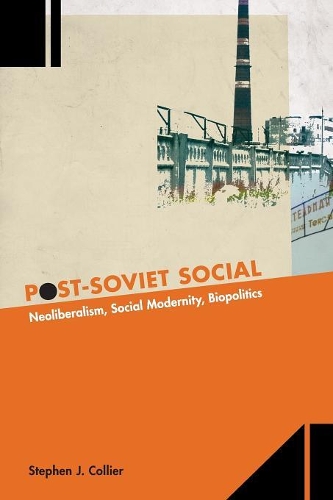
Post-Soviet Social :Neoliberalism, Social Modernity, Biopolitics
paperback
Published:
23 August, 2011

Popular Books by Stephen J. Collier
View All Books by Stephen J. Collier


Description
More Details
| Type | Book |
|---|---|
| ISBN13 | 9780691148311 |
| ISBN10 | 0691148317 |
| Number Of Pages | 312 |
| Item Weight | 454 g |
| Publisher / Reseller | Princeton University Press |
| Format | paperback |
Media Reviews
"[T]he overall arguments are clearly and exhaustively explicated, and Collier demonstrates a strong grasp of economics and economic history... [M]uch is provided that will interest a variety of scholars of political economy, as well as those with areal interests."--Samuel Schueth, Social Anthropology "Ambitious in its scope and level of detail, theoretically sophisticated and empirically rich, Collier's latest book makes an important contribution to Foucauldian scholarship. In particular, it helps us appreciate the significance and uniqueness of the Soviet biopolitical project, while suggesting a productive line of inquiry into the nexus between neoliberalism and social modernity. It also encourages us to critically interrogate neoliberal narratives in terms of their history and effects, to appreciate the flexibility of neoliberal reforms and to focus on specific practices in order to understand what makes them neoliberal."--Volha Piotukh, Foucault Studies "[B]y advocating the study of the actual ideas and policies, not merely the political manifestos, of economists and international financial institutions like the World Bank, as they change in interaction with material and social structures, Collier advances our understanding of socialism, postsocialism, and neoliberalism. This book would be useful in graduate courses on neoliberalism and postsocialism."--Johanna Bockman, Slavic Review "Undoubtedly, Collier's book is complex, yet highly rewarding, and this reviewer is certain that this book will transform not only our perception of how neoliberal reform actually worked in places like post-Soviet Russia, but also how we approach neoliberalism as an object of anthropological inquiry."--Valter Cvijic, Anthropological Notebooks
Author's Bio
Stephen J. Collier is an anthropologist and assistant professor in the Graduate Program in International Affairs at The New School. He is the coeditor of "Bio-security Interventions" and "Global Assemblages".