The Limits of Convergence :Globalization and Organizational Change in Argentina, South Korea, and Spain

4.00 ( 1 Ratings by Goodreads)
The Limits of Convergence

The Limits of Convergence :Globalization and Organizational Change in Argentina, South Korea, and Spain

4.00 (1 Ratings by Goodreads)
paperback
Published: 15 August, 2003
Standard worldwide delivery by Mon, July 13 - Thu, July 16
Order within 0
Condition: NEW
$53.59
RRP $59.33
You save $5.74 (10%)
Price includes shipping
Available 1 in stock
- +
FREE Returns within 30 days

Description

This book challenges the widely accepted notion that globalization encourages economic convergence--and, by extension, cultural homogenization--across national borders. A systematic comparison of organizational change in Argentina, South Korea, and Spain since 1950 finds that global competition forces countries to exploit their distinctive strengths, resulting in unique development trajectories. Analyzing the social, political, and economic conditions underpinning the rise of various organizational forms, Guillen shows that business groups, small enterprises, and foreign multinationals play different economic roles depending on a country's path to development. Business groups thrive when there is foreign-trade and investment protectionism and are best suited to undertake large-scale, capital-intensive activities such as automobile assembly and construction. Their growth and diversification come at the expense of smaller firms and foreign multinationals. In contrast, small and medium enterprises are best fitted to compete in knowledge-intensive activities such as component manufacturing and branded consumer goods. They prosper in the absence of restrictions on export-oriented multinationals. The book ends on an optimistic note by presenting evidence that it is possible--though not easy--for countries to break through the glass ceiling separating poor from rich. It concludes that globalization encourages economic diversity and that democracy is the form of government best suited to deal with globalization's contingencies. Against those who contend that the transition to markets must come before the transition to ballots, Guillen argues that democratization can and should precede economic modernization. This is applied economic sociology at its best--broad, topical, full of interesting political implications, and critical of the conventional wisdom.
See more

More Details

Type Book
ISBN13 9780691116334
ISBN10 0691116334
Number Of Pages 304
Item Weight 397 g
Publisher / Reseller Princeton University Press
Format paperback
See More +

Media Reviews

"This book offers a sophisticated and lively analysis of three well-researched and important cases of distinctive political economies. It is a valuable contribution to the debate about the impact of globalization on national trajectories and the varieties of capitalism in the modern world."--Anthony W. Pereira, Political Science Quarterly "A very ambitious study, striding across a number of disciplines... This is a groundbreaking contribution to the study of business organization and economic development."--International Affairs "This is an important book: theoretically nuanced, comparative in the best sense, and empirically rich."--Stephen Haggard, American Journal of Sociology "The strength of this book is its comparative and historical approach to the study of organizational and institutional change... [A]n informative work and a valuable contribution to the literatures on these countries and to debates about globalization generally."--Robert K. Schaeffer, Social Forces

Show more

GoodReads Reviews

Author's Bio

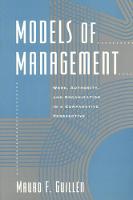
Mauro F. Guillen is Associate Professor of Management and of Sociology at the Wharton School of the University of Pennsylvania. A former Guggenheim Fellow, he is the author of "Models of Management: Work, Authority, and Organization in a Comparative Perspective" and the coauthor of "The AIDS Disaster".

Show more