Making Democracy Work :Civic Traditions in Modern Italy
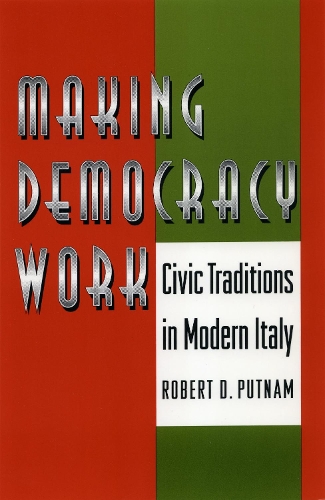
Making Democracy Work :Civic Traditions in Modern Italy
paperback
Published:
13 July, 1994

Popular Books by Robert D. Putnam
View All Books by Robert D. Putnam

Description
Prizes
Winner of National Academy of Public Administration Louis Brownlow Award 1993,Runner-up for AAP/Professional and Scholarly Publishing Awards: Government and Political Science 1993
More Details
| Type | Book |
|---|---|
| ISBN13 | 9780691037387 |
| ISBN10 | 0691037388 |
| Number Of Pages | 272 |
| Item Weight | 369 g |
| Publisher / Reseller | Princeton University Press |
| Format | paperback |
Media Reviews
Winner of the 1994 Charles H. Levine Memorial Book Prize Winner of the 1994 Gregory Luebbert Award Winner of the 1993 Louis Brownlow Book Award, National Academy of Public Administration Honorable Mention for the 1993 Award for Best Professional/Scholarly Book in Government and Political Science, Association of American Publishers "Seminal, epochal, path-breaking: All those overworked words apply to a book that, to make the point brazenly, is a Democracy in America for our times."--David L. Kirp, The Nation "A great work of social science, worthy to rank alongside de Tocqueville, Pareto, and Weber... If [Putnam's] claims about the essential conditions of successful democracy are correct (and they almost certainly are), then politicians and political scientists alike will have to think again about democracy's prospects in Asia, Latin America, and Eastern Europe."--The Economist "A remarkable study of 'civic traditions.'"--Steven Lukes, The Times Literary Supplement "It is rare that one comes across a classic in political science, yet in Robert D. Putnam's Making Democracy Work we undoubtedly have one... Mr. Putnam's seminal work addresses in a rigorously empirical way the central question of democratic theory: What makes democratic institutions stable and effective? ... [His] findings strikingly corroborate the political theory of civic humanism, according to which strong and free government depends on a virtuous and public-spirited citizenry--on an undergirding civic community... One crucial implication of Making Democracy Work is that feeble and corrupt government, operating against the background of a weak and uncivic society, tends not to foster the creation of wealth, but rather to renew poverty. Overmighty government may stifle economic initiative. But enfeebled government and unrepresentative government kills it, or diverts it into corruption and criminality... This may not, perhaps, be a universal truth; but it is directly relevant to the prospects of democracy in the United States today."--The New York Times Book Review
Author's Bio
Robert D. Putnam is the Malkin Research Professor of Public Policy at Harvard University and a former dean of the John F. Kennedy School of Government. He is an internationally renowned scholar and bestselling author whose acclaimed books include Bowling Alone, Our Kids, and The Upswing. In 2012, President Obama awarded him the National Humanities Medal, the nation’s highest honor for contributions to the humanities. His research program, the Saguaro Seminar, is dedicated to fostering civic engagement in America. Robert Leonardi is visiting professor in the School of Government at the LUISS University in Rome. Raffaella Y. Nanetti is professor emerita in urban planning and policy at the University of Illinois at Chicago.