Perfect Form :Variational Principles, Methods, and Applications in Elementary Physics
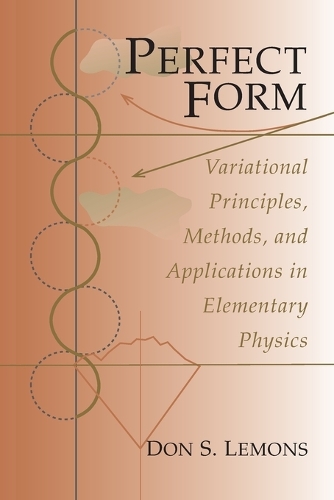
Perfect Form :Variational Principles, Methods, and Applications in Elementary Physics
paperback
Published:
17 April, 1997
paperback
Published:
17 April, 1997

Standard worldwide delivery by
Fri, June 19 - Wed, June 24
Order within
0
Condition:
NEW
$66.73
RRP
$77.89
You save $11.16 (14%)
Available
1
in stock
FREE Returns within 30 days
Popular Books by Don S. Lemons
View All Books by Don S. Lemons


Description
What does the path taken by a ray of light share with the trajectory of a thrown baseball and the curve of a wheat stalk bending in the breeze? Each is the subject of a different study yet all are optimal shapes; light rays minimize travel time while a thrown baseball minimizes action. All natural curves and shapes, and many artificial ones, manifest such "perfect form" because physical principles can be expressed as a statement requiring some important physical quantity to be mathematically maximum, minimum, or stationary. Perfect Form introduces the basic "variational" principles of classical physics (least time, least potential energy, least action, and Hamilton's principle), develops the mathematical language most suited to their application (the calculus of variations), and presents applications from the physics usually encountered in introductory course sequences. The text gradually unfolds the physics and mathematics. While other treatments postulate Hamilton's principle and deduce all results from it, Perfect Form begins with the most plausible and restricted variational principles and develops more powerful ones through generalization. One selection of text and problems even constitutes a non-calculus of variations introduction to variational methods, while the mathematics more generally employed extends only to solving simple ordinary differential equations. Perfect Form is designed to supplement existing classical mechanics texts and to present variational principles and methods to students who approach the subject for the first time.
More Details
| Type | Book |
|---|---|
| ISBN13 | 9780691026633 |
| ISBN10 | 0691026637 |
| Number Of Pages | 136 |
| Item Weight | 170 g |
| Publisher / Reseller | Princeton University Press |
| Format | paperback |
See More +
Media Reviews
"[The] ability of variational methods to derive fundamental results in physics hints at their being a kind of short cut towards truly fundamental insights into the design of the cosmos... Don Lemon's short book is aimed at bringing these techniques within reach of the average undergraduate physics student."--Robert Matthews, New Scientist
Author's Bio
Don S. Lemons is Associate Professor of Physics at Bethel College of North Newton, Kansas.