When you buy a used copy YOU SAVE

1.28Kg of CO2

160 litre(s) of Water

0.0096 Tree(s)

1 book donated to global literacy projects
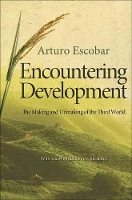
Encountering Development: The Making and Unmaking of the Third World (Princeton Studies in Culture/Power/History) - Princeton Studies in Culture/Power/History
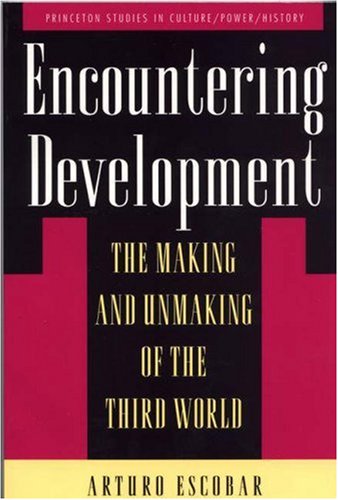
Encountering Development: The Making and Unmaking of the Third World (Princeton Studies in Culture/Power/History) - Princeton Studies in Culture/Power/History
paperback
Published:
14 November, 1994
paperback
Published:
14 November, 1994

Standard worldwide delivery by
Wed, June 17 - Mon, June 22
Order within
0

Condition:
USED
$13.03
RRP
$26.61
You save $13.58 (51%)
Available
1
in stock
FREE Returns within 30 days
Popular Books by Arturo Escobar
View All Books by Arturo Escobar


Description
How did the industrialized nations of North America and Europe come to be seen as the appropriate models for post-World War II societies in Asia, Africa, and Latin America? How did the postwar discourse on development actually create the so-called Third World? And what will happen when development ideology collapses? To answer these questions, Arturo Escobar shows how development policies became mechanisms of control that were just as pervasive and effective as their colonial counterparts. The development apparatus generated categories powerful enough to shape the thinking even of its occasional critics while poverty and hunger became widespread. 'Development' was not even partially 'deconstructed' until the 1980s, when new tools for analyzing the representation of social reality were applied to specific 'Third World' cases. Here Escobar deploys these new techniques in a provocative analysis of development discourse and practice in general, concluding with a discussion of alternative visions for a postdevelopment era.
Escobar emphasizes the role of economists in development discourse - his case study of Colombia demonstrates that the economization of food resulted in ambitious plans, and more hunger. To depict the production of knowledge and power in other development fields, the author shows how peasants, women, and nature became objects of knowledge and targets of power under the 'gaze of experts'.
More Details
| Type | Book |
|---|---|
| ISBN13 | 9780691001029 |
| ISBN10 | 0691001022 |
| Number Of Pages | 320 |
| Item Weight | 421 g |
| Product Dimensions | 154 x 20 x 230 mm |
| Publisher / Reseller | Princeton University Press |
| Format | paperback |
See More +
Media Reviews
Arturo Escobar has given us an important and exciting take on issues of Third World development and its alternatives... [This book] indisputably provides some exciting and significant new ways of thinking about development... Arturo Escobar has done us all a service. -- Contemporary Sociology
Author's Bio
Arturo Escobar is Associate Professor of Anthropology at the University of Massachusetts, Amherst. He recently taught at Smith College.