When you buy a used copy YOU SAVE

1.02Kg of CO2

128 litre(s) of Water

0.0077 Tree(s)

1 book donated to global literacy projects
Cheating Monkeys and Citizen Bees :The Nature of Cooperation in Animals and Humans
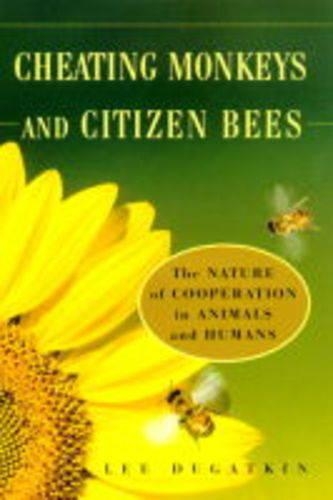
Cheating Monkeys and Citizen Bees :The Nature of Cooperation in Animals and Humans
hardback
Published:
10 August, 1999
hardback
Published:
10 August, 1999

Standard worldwide delivery by
Tue, July 7 - Fri, July 10
Order within
0

Condition:
USED
$9.23
RRP
$22.44
You save $13.21 (59%)
Available
1
in stock
FREE Returns within 30 days
Popular Books by Lee Alan Dugatkin
View All Books by Lee Alan Dugatkin
Description
Cooperation is the fabric that keeps society together. Civilization could not have been achieved - and will not be sustained - without it. But what is it? How and why does it work? Could the secret of enhancing human cooperation lie in an investigation of the animal kingdom? In Cheating Monkeys and Citizen Bees, evolution and animal behavior expert Professor Lee Dugatkin, known throughout the academic community for his ingenious animal behavior experiments, reports from the cutting edge of scientific research on the startling evolutionary truth about cooperation and how it works. He explains the four paths to cooperation that we share with animals and provides the experimentally verified definitions of a behavior no one thought science could ever explain. Those readers with an interest in ecology, evolutionary biology, psychology, even anthropology will find Cheating Monkeys and Citizen Bees an essential handbook of the dynamics of cooperation. And everyone will find it to be a lucid introduction to the surprising evolutionary history of how we came to behave in the ways that we do, of how nature came to be less brutal than we tend to think.
More Details
| Type | Book |
|---|---|
| ISBN13 | 9780684843414 |
| ISBN10 | 0684843412 |
| Number Of Pages | 256 |
| Item Weight | 378 g |
| Publisher / Reseller | Simon & Schuster Ltd |
| Format | hardback |
See More +
Media Reviews
Professor Bert Holldobler coauthor with E.O. Wilson of The Ants Why should individuals in a population cooperate rather than compete? Do the evolutionary blueprints for cooperation in ant societies and among humans have anything in common? Lee Alan Dugatkin's new book is a highly readable account of such intriguing subjects, and easily accessible for all readers interested in the biological roots of cooperation.