Interpretation and Social Criticism - The Tanner Lectures on Human Values
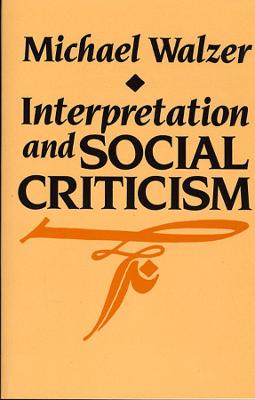
Interpretation and Social Criticism - The Tanner Lectures on Human Values
paperback
Published:
14 November, 1993

Popular Books by Michael Walzer
View All Books by Michael Walzer





Description
What do social critics do? I How do they go about doing it? Where do their principles come from? How do critics establish their distance from the people and institutions they criticize?
Michael Walzer addresses these problems in succinct and engaging fashion, providing a philosophical framework for understanding social criticism as a social practice. Walzer maintains that social criticism is an ordinary activity—less the offspring of scientific knowledge than the “educated cousin of common complaint”—and does not depend for its force or accuracy upon any sort of high theory. In his view, the social critic is not someone radically detached and disinterested, who looks at society as a total stranger and applies objective and universal principles. The true social critic must stand only a little to the side of his society—unlike Jean-Paul Sartre during the Algerian war, for example, who described himself as an enemy of his own people. And unlike Lenin, who judged Russian society against a standard worked out with reference to other places far away.
The “connected” critic is the model Walzer offers, one whose distance is measured in inches but who is highly critical nevertheless. John Locke is one example of the connected critic who argued for religious toleration not as a universal right ordained by reason but as a practical consequence of Protestant theology. The biblical prophets, such as Amos, were also men of their own day, with a particular quarrel to conduct with their fellows; the universalism of that quarrel is our own extrapolation. Walzer explains where critical principles come from, how much distance is “critical distance,” and what the historical practice of criticism has actually been like in the work of social philosophers such as Marx, Gramsci, Koestler, Lenin, Habermas, and Rawls.
Walzer posits a moral world already in existence, a historical product, that gives structure to our lives but whose ordinances are always uncertain and in need of scrutiny, argument, and commentary. The social critic need bring to his task only the ordinary tools of interpretation. Philosophers, political theorists, and all readers seriously interested in the possibility of a moral life will find sustenance and inspiration in this book.
More Details
| Type | Book |
|---|---|
| ISBN13 | 9780674459717 |
| ISBN10 | 0674459717 |
| Number Of Pages | 108 |
| Item Weight | 159 g |
| Product Dimensions | 140 x 210 x 8 mm |
| Publisher / Reseller | Harvard University Press |
| Format | paperback |
Media Reviews
[Interpretation and Social Criticism] is learned, cogent, and provocative. It avoids the pretensions of both scientific certainty and grand theory and treats social criticism as the ‘educated cousin of common complaint.’ It also succeeds brilliantly in making an ancient religion relevant to the contemporary political imagination, which perhaps confirms Santayana’s point that the prophet is he who draws truth from fable. -- John Patrick Diggins * New York Times Book Review *
Interpretation and Social Criticism is clearly written and extremely relevant to contemporary debates, both in Europe and North America, on criticism, theory, and the role of intellectuals in the formation of social movements and the making of social change. -- Harvey J. Kay * Socialism and Democracy *
A rich and lyrical reflection on the practice of social criticism and interpretation, and on the formation of moral standards, by one of our finest social thinkers… Every culture, Walzer says, if it is to thrive, must listen to the voices of its own prophets. Wonderfully clear, and informed by a deep commitment to democratic values. * Choice *
GoodReads Reviews
Author's Bio
Michael Walzer is Professor of Social Science at the Institute for Advanced Study, Princeton.