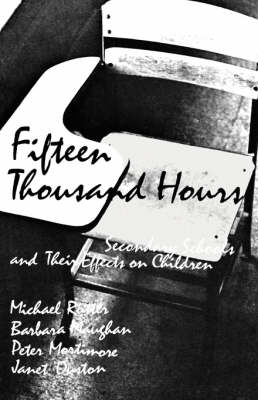
Fifteen Thousand Hours :Secondary Schools and Their Effects on Children
Fifteen Thousand Hours :Secondary Schools and Their Effects on Children
paperback
Published:
15 March, 1982

Popular Books by Michael Rutter
View All Books by Michael Rutter


Description
Can a good school help its students overcome the adverse effects of economic disadvantage and family adversity? Recent educational assessment suggests that the answer may be a painful no. Here, however, is a book that contradicts the prevailing pessimism about the possibilities of education. In Fifteen Thousand Hours, Michael Rutter and his colleagues show conclusively that schools can make a difference.
In a three-year study of a dozen secondary schools in a large urban area, Rutter's team found that some schools were demonstrably better than others at promoting the academic and social success of their students. Moreover, there were clear and interesting differences between the schools that promote success and the schools that promote failure. As Rutter shows, these differences provide important clues to the kind of educational reform that might allow inner-city schools to act more uniformly as a positive and protective influence on students who must grow up in an otherwise disordered and difficult world.
For a dozen years during their formative period of development, children spend as many of their working hours at school as at home—some 15,000 hours in all. To suggest that this tremendous amount of time has no effect on development seems irrational. To settle for schools that simply act as institutions of containment for disadvantaged children seems a strategy of despair. The importance of this major book in education is its clear demonstration that these are not the only alternatives.
More Details
| Type | Book |
|---|---|
| ISBN13 | 9780674300262 |
| ISBN10 | 0674300262 |
| Number Of Pages | 294 |
| Item Weight | 318 g |
| Publisher / Reseller | Harvard University Press |
| Format | paperback |
Media Reviews
[Rutter’s] findings, backed up with impressive statistics, fly in the face of a popular American theory that holds that if a student body has too many social disadvantages, there is not much that can be done for it educationally. * New York Times *
This important document should he taken seriously by all who are concerned with schooling… [It] confirms common sense: that approximately 15,000 hours spent in schools does matter. It says that schools are complex social institutions in which many factors merge to create an atmosphere that can influence pupil outcomes differentially, regardless of pupil background. It offers hope that schools can be improved no matter where they are located. And it offers provocative findings that beg for serious attention and further research investigation. * American Journal of Orthopsychiatry *