Transforming India :Challenges to the World’s Largest Democracy
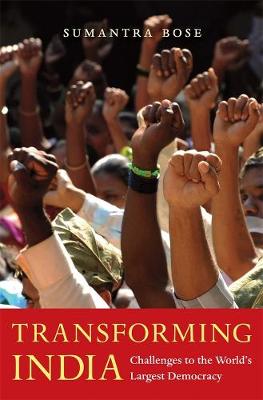
Transforming India :Challenges to the World’s Largest Democracy
hardback
Published:
9 September, 2013

Popular Books by Sumantra Bose
View All Books by Sumantra Bose
Description
A nation of 1.25 billion people composed of numerous ethnic, linguistic, religious, and caste communities, India is the world’s most diverse democracy. Drawing on his extensive fieldwork and experience of Indian politics, Sumantra Bose tells the story of democracy’s evolution in India since the 1950s—and describes the many challenges it faces in the early twenty-first century.
Over the past two decades, India has changed from a country dominated by a single nationwide party into a robust multiparty and federal union, as regional parties and leaders have risen and flourished in many of India’s twenty-eight states. The regionalization of the nation’s political landscape has decentralized power, given communities a distinct voice, and deepened India’s democracy, Bose finds, but the new era has also brought fresh dilemmas.
The dynamism of India’s democracy derives from the active participation of the people—the demos. But as Bose makes clear, its transformation into a polity of, by, and for the people depends on tackling great problems of poverty, inequality, and oppression. This tension helps explain why Maoist revolutionaries wage war on the republic, and why people in the Kashmir Valley feel they are not full citizens. As India dramatically emerges on the global stage, Transforming India: Challenges to the World’s Largest Democracy provides invaluable analysis of its complexity and distinctiveness.
Prizes
Nominated for Robert Jervis and Paul Schroeder Best Book Award 2014,Nominated for Bernard Schwartz Book Award 2014,Nominated for J. David Greenstone Book Prize 2014,Nominated for John F. Richards Prize 2014,Nominated for Lepgold Book Prize 2013
More Details
| Type | Book |
|---|---|
| ISBN13 | 9780674050662 |
| ISBN10 | 0674050665 |
| Number Of Pages | 352 |
| Item Weight | 1000 g |
| Publisher / Reseller | Harvard University Press |
| Format | hardback |
Media Reviews
The book tells the story of democracy’s evolution in India from the 1950s and makes the excellent point that, over the past two decades, India has changed from a country dominated by a single nationwide party into a robust multiparty, federal union. The regionalization of the nation’s political landscape has decentralized power, given communities a distinct voice and deepened India’s democracy. -- Gurcharan Das * Wall Street Journal *
Bose lucidly analyzes India’s ‘decentered democracy,’ in which power lies increasingly with the state governments… The willingness of most Indians to commit to multiple social identities has produced a distinctive form of democratic politics. In revealing both the violence and the vitality of India’s democracy, Bose sees the country’s future prosperity and stability as anything but assured. -- Andrew J. Nathan * Foreign Affairs *
Bose offers a crisp and sweeping discussion of the political history of India from its independence in 1947 to the dilemmas and challenges it faces today… The author’s discussion of the scattered but persistent Maoist movement(s) in India, and the alienation and subnationalist stirrings evident in some provinces (particularly Kashmir), is rich and evocative… The discussion is always nuanced, the judgments sound, and the language elegant. -- A. Ahmad * Choice *
Bose surveys the trajectory of India’s democracy in the nearly seven decades since the country won its independence from the British. He does a masterly job of showing the political transformation from a powerful central government exercising a ‘top-down authority’ over the states and with the dominance of a single party (the Congress Party) to the emergence of several regional parties. Today these mass-based regional parties and their leaders are significant players; they decide who governs at the center. Bose argues that this change in the political scene is evidence of ‘a robust democracy.’ Other subjects explored are the political odyssey in West Bengal from partition to the present and the rise and fall of three generations of Maoist insurgencies in India. The section on Kashmir provides sound historical context for the events in this troubled area… Bose’s work fills in the connections needed to understand the political complexities of India’s democracy. -- Ravi Shenoy * Library Journal *
Transforming India is a fast-paced and absorbing account by a first-rate author. Bose is a superb guide through the intricacies of India’s democracy and a sober witness to the extraordinary challenges it faces. It is essential reading for anyone interested in the future for political liberty in one of Asia’s great civilizations. A terrific book. -- Nur Yalman, Harvard University
Author's Bio
Sumantra Bose is Professor of International and Comparative Politics at the London School of Economics and Political Science.