Renouncing the World yet Leading the Church :The Monk-Bishop in Late Antiquity
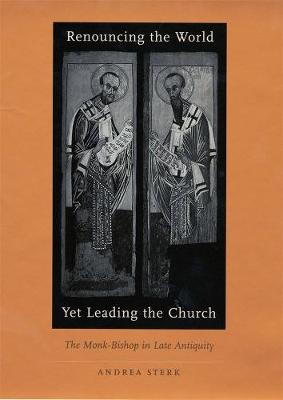
Renouncing the World yet Leading the Church :The Monk-Bishop in Late Antiquity
hardback
Published:
28 March, 2004

Popular Books by Andrea Sterk
View All Books by Andrea Sterk

Description
Although an ascetic ideal of leadership had both classical and biblical roots, it found particularly fertile soil in the monastic fervor of the fourth through sixth centuries. Church officials were increasingly recruited from monastic communities, and the monk-bishop became the dominant model of ecclesiastical leadership in the Eastern Roman Empire and Byzantium. In an interesting paradox, Andrea Sterk explains that "from the world-rejecting monasteries and desert hermitages of the east came many of the most powerful leaders in the church and civil society as a whole."
Sterk explores the social, political, intellectual, and theological grounding for this development. Focusing on four foundational figures--Basil of Caesarea, Gregory of Nyssa, Gregory of Nazianzus, and John Chrysostom--she traces the emergence of a new ideal of ecclesiastical leadership: the merging of ascetic and episcopal authority embodied in the monk-bishop. She also studies church histories, legislation, and popular ascetic and hagiographical literature to show how the ideal spread and why it eventually triumphed. The image of a monastic bishop became the convention in the Christian east.
Renouncing the World Yet Leading the Church brings new understanding of asceticism, leadership, and the church in late antiquity.
More Details
| Type | Book |
|---|---|
| ISBN13 | 9780674011892 |
| ISBN10 | 0674011899 |
| Number Of Pages | 368 |
| Item Weight | 676 g |
| Product Dimensions | 156 x 235 x 32 mm |
| Publisher / Reseller | Harvard University Press |
| Format | hardback |
Media Reviews
Sterk offers a study of bishops of the early Christian period and their pursuit of the 'mixed life.' Bishops lived in the world: they traveled from their see to synods; they petitioned court functionaries; they engaged in ecclesiastical politics and corresponded on doctrinal and administrative matters. Some admired the monastic life while simultaneously grappling with worldly affairs, wishing to adopt the discipline and ideals of monks and apply the ethics and asceticism of the monastery to the governance of the church. One such bishop was Basil of Caesarea, who wrote extensively on the need for bishops, like abbots, to be above reproach, to be careful in the selection of subordinates, and not to be forgetful of prayer and instruction. The author provides a well-written survey of Basil's conceptualization of the relevance of the monastic life for church leaders, follows up with a review of the impact of Basilian literature on Gregory of Nyssa, and provides a clear account of the further evolution of the concept of the 'monk as guide' in the thought of Gregory Nazianzus and John Chrysostom. Lively style, no pomposity. -- J. W. Nesbitt * Choice *
Author's Bio
Andrea Sterk is Assistant Professor of History, University of Florida.