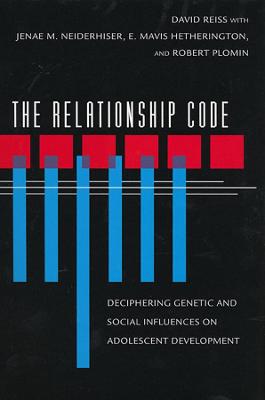
The Relationship Code :Deciphering Genetic and Social Influences on Adolescent Development - Adolescent Lives
The Relationship Code :Deciphering Genetic and Social Influences on Adolescent Development - Adolescent Lives
paperback
Published:
29 June, 2003

Popular Books by David Reiss
View All Books by David Reiss


Description
The Relationship Code is the report of a longitudinal study, conducted over a ten-year period, of the influence of family relationships and genetic factors on competence and psychopathology in adolescent development. The sample for this landmark study included 720 pairs of same-sex adolescent siblings—including twins, half siblings, and genetically unrelated siblings—and their parents.
Using a clear expressive style, David Reiss and his coinvestigators identify specific mechanisms that link genetic factors and the social environment in psychological development. They propose a striking hypothesis: family relationships are crucial to the expression of genetic influences on a broad array of complex behaviors in adolescents. Moreover, this role of family relationships may be very specific: some genetic factors are linked to mother–child relationships, others to father–child relations, some to relationship warmth, while others are linked to relationship conflict or control. The specificity of these links suggests that family relationships may constitute a code for translating genetic influences into the ontogeny of behaviors, a code every bit as important for behavior as DNA-RNA.
More Details
| Type | Book |
|---|---|
| ISBN13 | 9780674011267 |
| ISBN10 | 0674011260 |
| Number Of Pages | 560 |
| Item Weight | 644 g |
| Publisher / Reseller | Harvard University Press |
| Format | paperback |
Media Reviews
This book is of fundamental importance in biobehavioral sciences. The authors, all distinguished research scientists with years of experience with genetic and social studies, advance the nature–nurture debate… They present a uniquely new view of genetic influences, namely, the genetic tendencies for certain beneficial styles and personality are influenced significantly by patterns of relationships. -- James M. Toolan, M.D. * American Journal of Psychotherapy *
The Relationship Code is a sophisticated blast of fresh air into what has become a stale and stuffy atmosphere of polarized rhetoric about the extent to which we are products of our genes or our environment… The conceptual model proposed by the authors…is light years ahead of most nature–nurture discussions in its recognition of the complex ways in which genetic and environmental influences play out over time… Rather than viewing genes and environment as independent factors, the authors view these forces as interdependent influences that respond to, anticipate, and influence each other as they unfold over time. -- Laurence Steinberg * Contemporary Psychology: APA Review of Books *
In the view of Reiss et al., family process…plays an integral role in the expression of a child’s genetic endowment… The Relationship Code epitomizes the very best in family research. [It] is likely to become a classic in family research and adolescent development. It is must reading for anyone interested in understanding the myriad ways that families shape the development of their children or in working with families to promote healthy relationships. -- Kevin Fiscella * Families, Systems, & Health *
The genius of The Relationship Code is that it provides a conceptually solid, data-driven account of how genetics and environment work hand in glove in the process of human development. -- Harold D. Grotevant * Perspectives in Biology and Medicine *
The result of this Herculean effort was a study complex in design and execution that yielded a mass of data… Reiss’s goal in this book is to leave no stone unturned in the effort to demonstrate the complex interplay of heritable, maturational, and social factors in shaping adolescent development…the results are rewarding—and Reiss takes great pains to help the reader to understand the findings emerging from the use of this sophisticated research design, integrating behavioral genetic approaches with those of family study and developmental psychology of adolescence… Without question, Reiss and his colleagues succeed in demonstrating the impact of ever-changing heritable influences on offspring personality on relationships with the family…this book makes it quite clear that both clinicians and family researchers must recognize the importance of examining heritable factors as intertwined with life experiences in understanding family ties across the course of life. -- Bertram J. Cohler * Social Service Review *
Author's Bio
David Reiss is Vivian Gill Distinguished Research Professor at George Washington University Medical Center. Jenae Neiderhiser is Assistant Research Professor at George Washington University Medical Center. E. Mavis Hetherington is James M. Page Professor of Psychology at the University of Virginia. Robert Plomin is Professor of Psychology at the Institute of Psychiatry in London.