Semblances of Sovereignty :The Constitution, the State, and American Citizenship
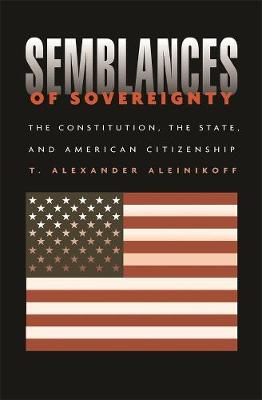
Semblances of Sovereignty :The Constitution, the State, and American Citizenship
hardback
Published:
29 June, 2002

Popular Books by T. Alexander Aleinikoff
View All Books by T. Alexander Aleinikoff
Description
In a set of cases decided at the end of the nineteenth century, the Supreme Court declared that Congress had "plenary power" to regulate immigration, Indian tribes, and newly acquired territories. Not coincidentally, the groups subject to Congress' plenary power were primarily nonwhite and generally perceived as "uncivilized." The Court left Congress free to craft policies of assimilation, exclusion, paternalism, and domination.
Despite dramatic shifts in constitutional law in the twentieth century, the plenary power case decisions remain largely the controlling law. The Warren Court, widely recognized for its dedication to individual rights, focused on ensuring "full and equal citizenship"--an agenda that utterly neglected immigrants, tribes, and residents of the territories. The Rehnquist Court has appropriated the Warren Court's rhetoric of citizenship, but has used it to strike down policies that support diversity and the sovereignty of Indian tribes.
Attuned to the demands of a new century, the author argues for abandonment of the plenary power cases, and for more flexible conceptions of sovereignty and citizenship. The federal government ought to negotiate compacts with Indian tribes and the territories that affirm more durable forms of self-government. Citizenship should be "decentered," understood as a commitment to an intergenerational national project, not a basis for denying rights to immigrants.
Prizes
Nominated for Ralph J. Bunche Award 2003
More Details
| Type | Book |
|---|---|
| ISBN13 | 9780674007451 |
| ISBN10 | 067400745X |
| Number Of Pages | 320 |
| Item Weight | 635 g |
| Product Dimensions | 156 x 235 x 32 mm |
| Publisher / Reseller | Harvard University Press |
| Format | hardback |
Media Reviews
Aleinikoff examines sovereignty, citizenship, and the broader concept of membership (aliens as well as citizens) in the American nation-state and suggests that American constitutional law needs ‘understandings of sovereignty and membership that are supple and flexible, open to new arrangements’… Sure to generate heated debate over the extent to which the rules governing immigration, Indian tribes, and American territories should be altered, this book is required reading for constitutional scholars. -- R. J. Steamer * Choice *
This book not only provides careful analysis of U.S. Supreme Court and congressional relationships but also could lead to novel studies of rights and obligations in American society. Highly recommended. -- Steven Puro * Library Journal *
What lends Aleinikoff’s work originality and importance is its synthetic range and the new insights that flow from bringing immigration, Indian, and territorial issues together, and taking on such much-criticized anomalies as the plenary power doctrine in their full ambit. In my view, he may well make good on his hope of helping to inspire a new field of sovereignty studies. Certainly, the idea of ‘problematizing’ national citizenship and national sovereignty is afoot in the law schools and, far more so, in sociology, political science, and in various interdisciplinary fields like American Studies, regional studies, and global political economy and cultural studies. To my knowledge, no one has written a synthetic treatment of these issues that compares with Aleinikoff’s in its mastery of constitutional law, its working knowledge or adjacent normative, historical and policy studies, and its intellectual clarity, stylistic grace, and morally sensitive but pragmatic political judgments. -- William Forbath, University of Texas at Austin Law School
Amid the overflowing scholarship on American constitutional law, little has been written on this cluster of topics, which go to the core of what sovereignty under the Constitution means. Aleinikoff asks not only how we define ‘ourselves,’ but exactly who is authorized to place themselves in the category of insiders empowered to set limits excluding others. The book stands out as a novel, intriguing, and interesting analysis against the sea of sameness found in the constitutional literature. -- Philip P. Frickey, Law School, University of California, Berkeley
Author's Bio
T. Alexander Aleinikoff is a professor at Georgetown Law Center and Senior Associate at the Migration Policy Institute (Washington, D.C.).