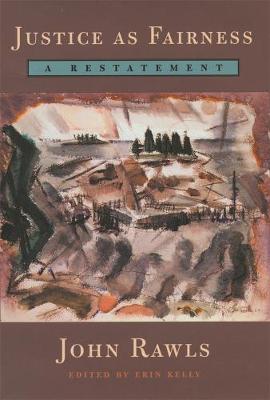
Justice as Fairness :A Restatement
Justice as Fairness :A Restatement
paperback
Published:
15 June, 2001

Popular Books by John Rawls
View All Books by John Rawls
![Justice as Fairness / Gerechtigkeit als Fairness: Englisch/Deutsch. [Great Papers Philosophie]](https://d32vymxhv9fq6b.cloudfront.net/images/books/medium/97831/9783150195864.jpg)
Description
This book originated as lectures for a course on political philosophy that Rawls taught regularly at Harvard in the 1980s. In time the lectures became a restatement of his theory of justice as fairness, revised in light of his more recent papers and his treatise Political Liberalism (1993). As Rawls writes in the preface, the restatement presents "in one place an account of justice as fairness as I now see it, drawing on all [my previous] works." He offers a broad overview of his main lines of thought and also explores specific issues never before addressed in any of his writings.
Rawls is well aware that since the publication of A Theory of Justice in 1971, American society has moved farther away from the idea of justice as fairness. Yet his ideas retain their power and relevance to debates in a pluralistic society about the meaning and theoretical viability of liberalism. This book demonstrates that moral clarity can be achieved even when a collective commitment to justice is uncertain.
Prizes
Nominated for Pulitzer Prizes 2002,Nominated for PROSE Awards 2001,Nominated for Society for the Study of Social Problems C. Wright Mills Award 2001,Nominated for Frederic W. Ness Book Award 2003,Nominated for Rachel Carson Prize & Ludwik Fleck Prize 2002,Nominated for Littleton-Griswold Prize 2002
More Details
| Type | Book |
|---|---|
| ISBN13 | 9780674005112 |
| ISBN10 | 0674005112 |
| Number Of Pages | 240 |
| Item Weight | 272 g |
| Publisher / Reseller | Harvard University Press |
| Format | paperback |
Media Reviews
Justice as Fairness is a concise, self-contained, and up to date presentation of Rawls' views...While Justice as Fairness does not present any theoretical departures from Political Liberalism, it deals with important topics Rawls never fully addressed before such as Marx's critique of liberalism and the moral short-comings of welfare state capitalism...Rawls' long-time readers will also be pleased to find that Justice as Fairness includes careful replies to Sandel, Sen, Okin and other critics on issues ranging from health care to the legal status of gender differences. -- Robert Briscoe * Boston Book Review *
Rawls is one of the two or three most important political thinkers of the 20th century. His accounts of 'justice as fairness' and of 'political liberalism' are among the most widely discussed and cited in the field of political philosophy...[Justice as Fairness] provides an integrated statement of his political theory, drawing together and presenting in a unified way, and for the first time, the major arguments and both strands of his work. Even though it is a challenging volume, it will no doubt be the principal introduction to his thinking...An essential text. -- J. D. Moon * Choice *
There have been millions of words written about A Theory of Justice and many articles and several books by Rawls defending and expanding its doctrines. Justice as Fairness will almost certainly be the last of these, and it should take its place as the best and most comprehensive statement of Rawls's eventual position. It is an exemplary work in every way. Rawls's own virtues shine through. He follows the argument where it leads. He listens to his critics and acknowledges his supporters; he gives way when it is necessary, but remains firm where he can take a stand. Anybody convinced that political thought is all about disguised power, or rhetoric, or ideology in the bad sense of the word, should confront this book. -- Simon Blackburn * Times Literary Supplement *
Author's Bio
John Rawls was James Bryant Conant University Professor at Harvard University. He was recipient of the 1999 National Humanities Medal. Erin Kelly is Professor of Philosophy at Tufts University.